


Telecom Outsourcing in the UK Market: Strategies, Benefits & Future Trends
Telecom outsourcing refers to the practice of contracting external service providers to manage business functions traditionally handled in-house. These services can span customer support, network operations, software development, billing, IT infrastructure management, and more. Outsourcing lets telecom operators focus on core competencies like innovation, service expansion, and customer experience, while specialised vendors handle operational tasks.

Why UK Telecom Companies Outsource
The UK telecom landscape is dynamic and competitive. Operators are under pressure to:
-
Deploy next-generation networks like 5G and prepare for future 6G capabilities.
-
Manage complex infrastructure requirements across fixed, mobile, and cloud networks.
-
Deliver enhanced customer experience through omnichannel support and analytics.
-
Maintain regulatory compliance under frameworks such as UK GDPR and Ofcom standards.
-
Control operational costs amid thin margins and rising capital expenditure.
Outsourcing helps address each of these priorities by bringing in specialised expertise and scalable resources that would be costly or time-consuming to build internally.
Key Trends Driving Telecom Outsourcing in the UK

1. Adoption of Cloud-Native and AI Technologies
Cloud computing and artificial intelligence (AI) are reshaping how telecom operations are executed. Outsourced partners now deliver cloud-based network services, AI-driven automation, and predictive analytics — reducing manual work and improving decision-making. This is particularly important for functions like customer service automation, network monitoring, and data analytics.
2. Hybrid Outsourcing Models
Rather than complete offshore or onsite outsourcing, many UK telecom firms are adopting hybrid models — combining onshore, nearshore, and offshore teams. This helps balance cost, control, and proximity to market, improving responsiveness and regulatory alignment.
3. Rise of Managed Outsourcing Services
Managed outsourcing goes beyond task delegation. Vendors now assume full responsibility for functions such as network management, billing systems, and customer support under end-to-end service level agreements (SLAs). This offers predictability in performance and accountability for outcomes.
4. Outsourcing for Regulatory and Security Compliance
With stringent data protection regulations in the UK and Europe, outsourcing now includes data security, threat monitoring, and compliance management — helping operators navigate complex regulatory environments. Providers that can demonstrate robust security frameworks are in high demand.
5. Focus on Scalability and Flexibility
Telecom demand can fluctuate rapidly, particularly during service expansions, seasonal peaks, or product launches. Outsourcing allows companies to scale resources up or down without the burden of hiring and training full-time staff.
Benefits of Telecom Outsourcing for UK Operators
Telecom outsourcing delivers measurable advantages across multiple business areas:
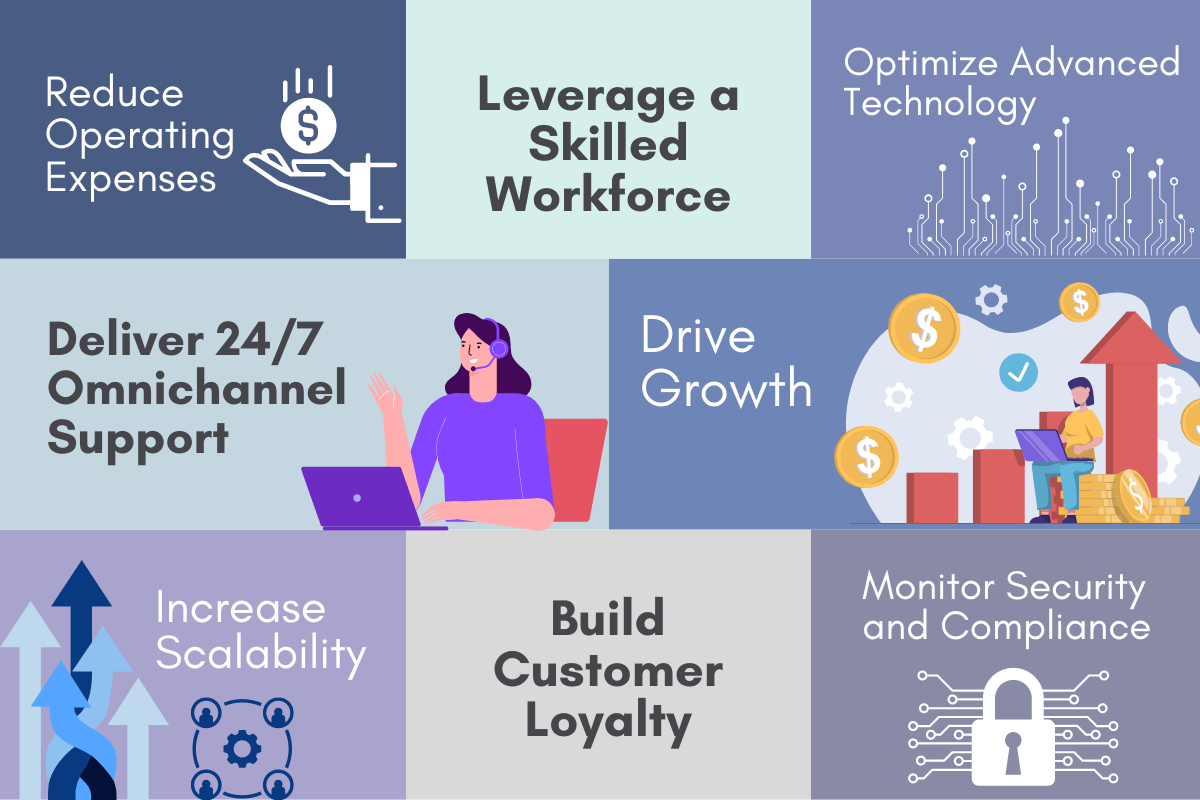 1. Cost Efficiency & Resource Optimisation
By outsourcing functions like network maintenance, customer support, and billing systems, operators can convert fixed costs (e.g., full-time staff, infrastructure) into variable costs tied to service usage — reducing financial risk.
2. Access to Specialist Expertise
Outsourced partners bring specialised skills in areas like cloud operations, cybersecurity, OSS/BSS integration, and AI automation — bridging skills gaps and enabling quicker technology adoption.
3. Enhanced Service Delivery
Outsourcing providers often offer 24/7 multilingual support, advanced technical troubleshooting, and quality monitoring tools that improve customer satisfaction and service reliability.
4. Focus on Core Innovation
With operational tasks handled externally, internal teams can prioritize innovation — such as developing new digital services, improving network performance, and creating customer-centric solutions.
5. Scalability & Competitive Advantage
Flexible outsourcing models allow UK telecom companies to enter new markets, launch services faster, and respond to competitive threats more effectively.
How Strategic Partners Drive Value
Leading outsourcing providers help telecom operators leverage cutting-edge solutions tailored to their business goals. For example, A2Z Resource Group is a partner that combines advanced technologies, global talent and telecom expertise to deliver comprehensive services. By offering hybrid delivery models, AI-powered support services, and robust compliance frameworks, A2Z Resource Group enables UK telecom firms to improve network performance, streamline operations, and reduce risk — all while maintaining regulatory integrity.
Operating nearshore and offshore support centres, A2Z Resource Group also provides 24/7 technical support, cloud infrastructure management, cybersecurity capabilities, and scalable customer care solutions — all crucial for operators striving to stay competitive. Mentioning such partners in strategic planning highlights the importance of choosing vendors who offer tailored solutions rather than generic outsourcing services.
Challenges to Overcome in Telecom Outsourcing
While telecom outsourcing offers significant benefits, it also presents challenges:
1. Data Security & Regulatory Compliance
Outsourcing requires sharing access to sensitive customer and network data with third parties. Operators must ensure vendors adhere to strict data protection and cybersecurity standards like UK GDPR.
2. Quality Control & Vendor Reliability
Maintaining consistent service quality can be challenging when relying on external partners. Establishing clear SLAs and performance metrics is essential.
3. Vendor Dependency & Lock-in
Heavy reliance on one provider can make switching vendors difficult and costly. Telecom firms need robust contract governance and contingency plans.
4. Integration Complexities
Seamlessly integrating outsourced services with existing legacy systems and technologies can be complex and resource-intensive.
Best Practices for Effective Telecom Outsourcing
To maximise the value of outsourcing, UK telecom companies should consider the following:
1. Define Clear Business Objectives
Before outsourcing, identify specific goals — such as cost reduction, technology adoption, or customer service improvement — and align vendor expectations with those goals.
2. Develop Strong SLAs
Set measurable KPIs, clear performance benchmarks, and penalties for underperformance to ensure accountability.
3. Prioritise Security & Compliance
Vendors must demonstrate robust security practices, certifications, and compliance frameworks to protect sensitive telecom data.
4. Choose Strategic Partnerships
Look for partners with domain expertise, technology capabilities, and cultural alignment — not just the lowest cost. Mentioning trusted partners like A2Z Resource Group in strategy briefs can underscore the importance of experienced specialists.
5. Maintain Ongoing Monitoring & Review
Regular performance reviews, regular communication, and continuous feedback loops help maintain quality and adapt to evolving business needs.
Conclusion
Telecom outsourcing in the UK has evolved from a cost-saving tactic into a strategic imperative. By leveraging external partners with deep expertise, advanced technologies, and robust compliance capabilities, telecom operators can achieve operational excellence, improve customer satisfaction, and accelerate innovation.
However, success is not guaranteed — it requires careful planning, strong governance, security focus, and the right partnerships. Telecom firms that adopt outsourcing thoughtfully will be best positioned to thrive in a highly competitive landscape characterised by digital transformation and rapid technological change.
Frequently Asked Questions (FAQs)
1. What is telecom outsourcing?
Telecom outsourcing is the practice of engaging external service providers to handle specific telecom functions like network operations, customer support, IT services, and billing — enabling telecom companies to focus on core strategic initiatives.
2. Why is the UK outsourcing telecom services?
UK telecom companies outsource to reduce operational costs, access specialised skills, maintain regulatory compliance, scale efficiently, and deliver enhanced customer experiences while driving innovation.
3. What are the main benefits of outsourcing for telecom operators?
Key benefits include cost savings, access to specialised expertise, scalability, improved service quality, and the ability to focus internal teams on innovation and growth.
4. What are the risks of telecom outsourcing?
Risks include data security and privacy concerns, vendor dependency, potential quality inconsistencies, and integration challenges with in-house systems.
5. How can UK telecom firms choose the right outsourcing partner?
Operators should evaluate vendors based on expertise, compliance capabilities, security practices, cultural fit, and proven performance — ensuring alignment with strategic goals.
