


🚀 Is It an Alien Ship? Harvard Scientist's Bold Claim on Interstellar Comet 3I/ATLAS’s “Overdrive” Engine
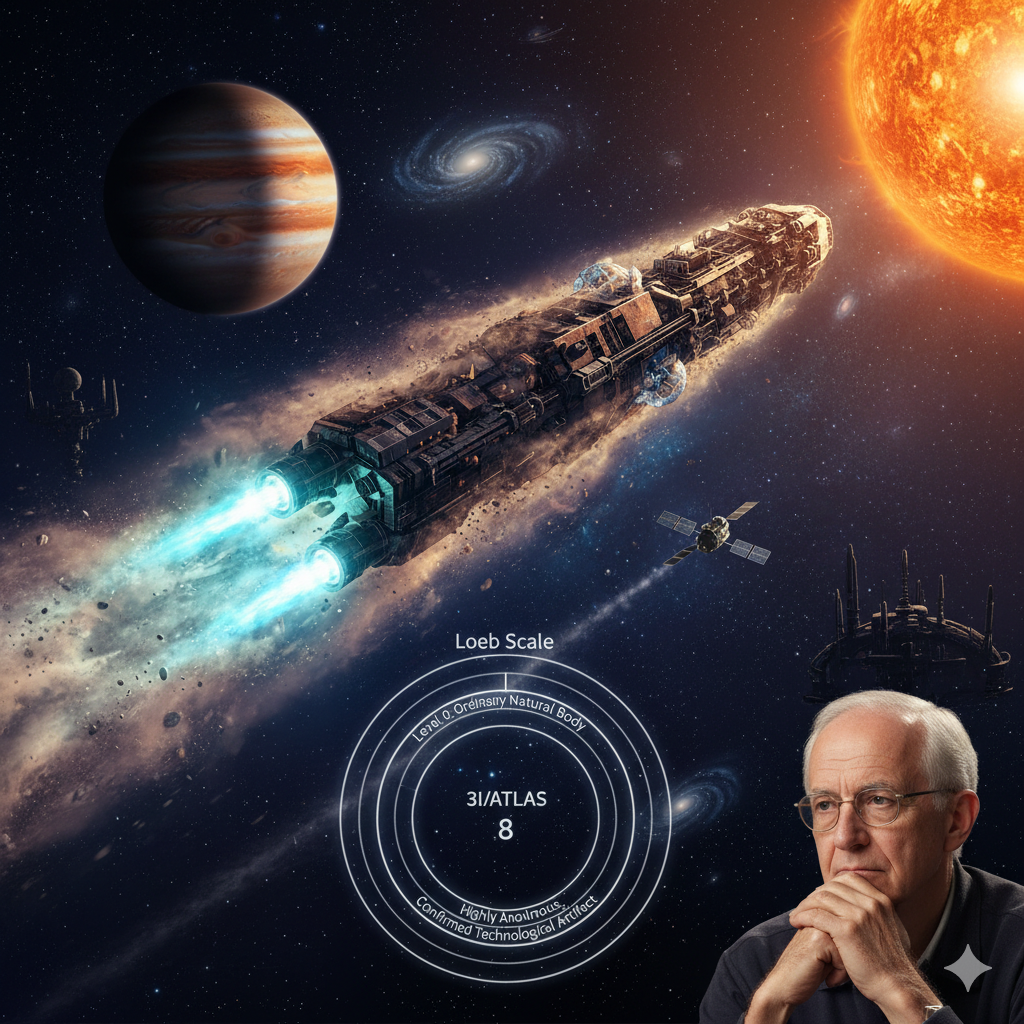
The cosmos has delivered a new mystery to our solar system: 3I/ATLAS, the third confirmed interstellar object. While it was initially classified as a comet, its journey has become anything but ordinary, sparking a sensational debate that echoes the mystery of the first interstellar visitor, 'Oumuamua. The central question? Why is it moving as if it has an engine in overdrive?
This is where a prominent Harvard scientist, Professor Abraham Loeb, has stepped into the spotlight, suggesting a provocative, yet scientifically valid, hypothesis: the object’s non-gravitational acceleration could be a sign of advanced extraterrestrial technology.
What is the 'Non-Gravitational' Acceleration?
The motion of all celestial bodies is predominantly governed by the gravitational pull of the Sun and the planets. However, when astronomers tracked the trajectory of 3I/ATLAS, they found a small but statistically significant deviation from a purely gravity-based path (Cloete et al., 2025). This unexplained push is known as non-gravitational acceleration (Micheli et al., 2018).
In most comets, this non-gravitational force is a well-understood phenomenon caused by outgassing—the sublimation of volatile ices (like water or carbon dioxide) from the comet’s nucleus as it heats up near the Sun. This process acts like a natural, low-level rocket thrust, nudging the comet off its expected course (Rafikov, 2018).
However, Professor Loeb and his collaborators have highlighted several anomalies concerning 3I/ATLAS:
-
Ambiguous Nature: Early observations presented an object that appeared to be large, consistent with an asteroid, but lacked clear spectral evidence of the extensive outgassing (gas production) you would expect for a typical comet with such a strong non-gravitational force (Hibberd et al., 2025; Jewitt et al., 2025). This ambiguity mirrors the controversy surrounding 'Oumuamua, which also exhibited non-gravitational acceleration without a visible coma (Seligman et al., 2024).
-
Unique Trajectory: 3I/ATLAS also possesses an orbital plane tilted only slightly from the ecliptic—an unusual alignment for an interstellar visitor that offers a "relative impunity" for an Extraterrestrial Intelligence (ETI) to access key planets like Jupiter (Hibberd et al., 2025).
Prof. Loeb's Hypotheses: Is it a 'Dark Forest' Probe?
The search results reveal that Professor Loeb, alongside colleagues, has not shied away from exploring the technological hypothesis, even as other research focuses on natural explanations like the sublimation of different ices, such as water or carbon dioxide (Jewitt et al., 2025; Bolin et al., 2025).
In one paper, they explore the possibility that 3I/ATLAS could be a sophisticated, non-natural object, potentially one that is "technological, and possibly hostile as would be expected from the 'Dark Forest' resolution to the 'Fermi Paradox'" (Hibberd et al., 2025).
Furthermore, they have even designed mission concepts, suggesting that the NASA Juno spacecraft—currently orbiting Jupiter—could be rerouted to intercept 3I/ATLAS in March 2026, when it makes its closest approach to the gas giant (Loeb et al., 2025).
Closest to the Sun: What Happened?
The interstellar comet's closest approach to the Sun, or perihelion, saw it pass as close as $1.356$ astronomical units (AU) (Jewitt et al., 2025). This close encounter was precisely when astronomers were looking for definitive proof of outgassing.
Observations conducted around this time, as the comet came within roughly $1.8$ to $4.6$ AU from the Sun, showed the development of a dust tail, a clear sign of activity. Scientists found the dust production rate was consistent with the sublimation of a volatile material like carbon dioxide being the primary driver of activity (Jewitt et al., 2025; Hibberd et al., 2025).
However, while the observations confirm activity, the scientific debate continues: is the observed activity fully sufficient to account for the magnitude of the mysterious non-gravitational acceleration?
Professor Loeb and his collaborators have also proposed the Loeb Scale, a structured, ten-level classification scheme to evaluate interstellar objects based on their anomalies, moving them from ordinary natural bodies (Level 0) to confirmed technological artifacts (Trivedi & Loeb, 2025). The sheer volume of analysis—from the possibility of an ice coma to the potential for a covert, reverse Solar Oberth Manoeuvre—demonstrates that the question of its nature remains open (Hibberd et al., 2025).
The interstellar object 3I/ATLAS has firmly taken its place as the next cosmic enigma, pushing the boundaries of cometary physics and reawakening the tantalizing possibility of an engineered visitor from beyond our solar system.
References
Bolin, B. T., Belyakov, M., Fremling, C., Graham, M. J., Abdelaziz, A. M., Elhosseiny, E., Gray, C. L., Ingebretsen, C., Jewett, G., Karpov, S., Kilic, M., Mašēk, M., Molham, M., Roderick, D., Takey, A., Lisse, C. M., Abron, L.-M., Coughlin, M. W., Hsieh, C.-H., Noll, K. S., & Wong, I. (2025). Interstellar comet 3I/ATLAS: discovery and physical description. Mon Not R Astron Soc Lett, 542(1), L139–L143.
Cloete, R., Loeb, A., & Vereš, P. (2025). Upper Limit on the Non-Gravitational Acceleration and Lower Limits on the Nucleus Mass and Diameter of 3I/ATLAS. arXiv.
Hibberd, A., Crowl, A., & Loeb, A. (2025). Is the Interstellar Object 3I/ATLAS Alien Technology?. arXiv. https://doi.org/10.48550/arXiv.2507.12213
Jewitt, D., Hui, M.-T., Mutchler, M., Kim, Y., & Agarwal, J. (2025). Hubble Space Telescope Observations of the Interstellar Interloper 3I/ATLAS. arXiv. https://doi.org/10.48550/arxiv.2508.02934
Loeb, A., Hibberd, A., & Crowl, A. (2025). Intercepting 3I/ATLAS at Closest Approach to Jupiter with the Juno spacecraft. arXiv. https://doi.org/10.48550/arxiv.2507.21402
Micheli, M., Farnocchia, D., Meech, K. J., Chambers, K. C., Luu, J. X., Weryk, R., Devogèle, M., Hainaut, O. R., Keane, J. V., Wainscoat, R. J., Tholen, D. J., Mazzotta Epifani, E., Shaefer, B. E., Jones, R. L., Schörghofer, N., Moorman, L., & Weaver, H. A. (2018). Non-Gravitational Acceleration in the Trajectory of 1I/2017 U1 (ʻOumuamua). The Astrophysical Journal, 855(2), L12.
Rafikov, R. R. (2018). Non-Gravitational Forces and Spin Evolution of Comets. arXiv. https://doi.org/10.48550/arxiv.1809.05133
Seligman, D. Z., Farnocchia, D., Micheli, M., Hainaut, O. R., Hsieh, H. H., Feinstein, A. D., Chesley, S. R., Taylor, A. G., Masiero, J., & Meech, K. J. (2024). Two distinct populations of dark comets delineated by orbits and sizes. Proceedings of the National Academy of Sciences, 121(2), e2406424121. https://doi.org/10.1073/pnas.2406424121
Trivedi, O., & Loeb, A. (2025). Quantitative Mapping of the Loeb Scale. arXiv. https://doi.org/10.48550/arxiv.2509.06253
