


China Cracks the Thorium Code: Molten-Salt Reactor Achieves Key Fuel Conversion
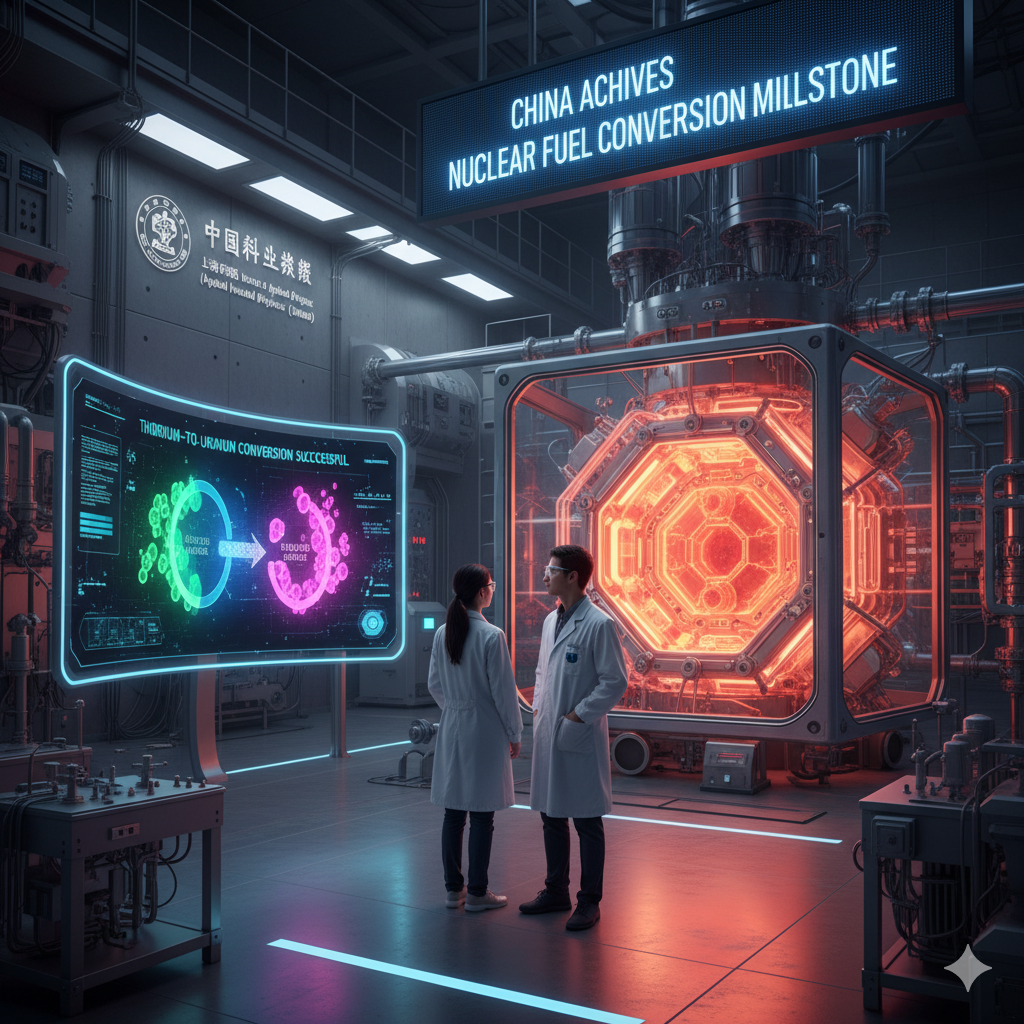
Shanghai, China—In a landmark achievement for next-generation nuclear energy, China has announced the successful conversion of thorium to fissile uranium fuel within its experimental Thorium Molten Salt Reactor (TMSR). This milestone confirms the technical viability of the thorium fuel cycle, long hailed as a safer and more sustainable alternative to traditional uranium-based nuclear power.
The breakthrough was achieved at the Chinese Academy of Sciences' Shanghai Institute of Applied Physics (SINAP), following the loading of thorium fuel into the prototype reactor. Valid experimental data was obtained, officially confirming the "breeding" process—where fertile thorium-232 absorbs a neutron and transmutes into the fissile material uranium-233.
Why This Matters: A New Dawn for Nuclear Power
This successful conversion is a pivotal moment for global energy, as it unlocks the potential of thorium, an element three to four times more abundant than uranium in the Earth's crust.
-
Vast Fuel Supply: China, with its substantial thorium reserves, is positioning itself for energy independence and a long-term, stable fuel source.
-
Inherent Safety: Molten-salt reactors (MSRs) like the TMSR are considered Fourth Generation advanced nuclear systems. They use high-temperature molten salt as both fuel carrier and coolant, which offers inherent safety features. The systems operate at atmospheric pressure and have passive shutdown mechanisms (like a frozen salt plug that melts to drain the fuel in an emergency), virtually eliminating the risk of catastrophic failures like meltdowns.
-
Reduced Waste: Thorium fuel cycles produce significantly less long-lived, high-level radioactive waste compared to conventional reactors, simplifying the long-term waste management challenge.
Paving the Way for a Carbon-Free Future
SINAP stated that this technological route aligns perfectly with China's abundance of thorium and its national goal of achieving carbon neutrality by 2060. The high-temperature output of MSRs also allows for deep integration with other clean energy industries, such as high-temperature hydrogen production, which is crucial for decarbonizing heavy industry.
The TMSR program, launched in 2011, has rapidly progressed from lab research to engineering verification. With a largely domestic supply chain for core components, China is accelerating its efforts. The ultimate objective is to construct a 100-megawatt demonstration project and realize its commercial application by 2035.
This accomplishment places China at the global frontier of nuclear innovation, capitalizing on initial concepts pioneered by the US decades ago but subsequently abandoned. For the world, it offers a tangible pathway toward a future with safe, clean, and near-limitless nuclear energy.
What are your thoughts on this nuclear breakthrough? Will thorium power redefine our energy future? Share your comments below!
