


The 'Mother of All Deals': India and EU Set to Seal Historic Trade Pact Amid Trump's Tariff Storm
January 24, 2026
In what is being hailed as a seismic shift in the global economic order, India and the European Union (EU) are on the verge of finalizing a Free Trade Agreement (FTA) after nearly 20 years of stop-and-go negotiations. European Commission President Ursula von der Leyen has famously dubbed it the "Mother of All Deals," a pact that will unite two of the world's largest democratic markets, representing 2 billion people and nearly 25% of global GDP.
The announcement is expected to be the crown jewel of the India-EU Summit on January 27, 2026, held in New Delhi, where Von der Leyen and European Council President António Costa are attending as Chief Guests for India's Republic Day celebrations.
The "Trump Factor": Why Now?
While talks began in 2007, the sudden urgency in 2026 is driven by a shared threat: unpredictable U.S. trade policy. Under President Donald Trump’s "America First" agenda, global trade has been upended:
-
Pressure on India: India is currently grappling with 50% tariffs on several key exports to the U.S.
-
Pressure on the EU: The Trump administration has threatened the EU with tariffs ranging from 10% to 25%, most recently using them as leverage in the ongoing Greenland purchase dispute.
Both New Delhi and Brussels are now moving with "pragmatic urgency" to diversify their supply chains and reduce their reliance on the volatile American market.
What’s in the Deal?
The agreement aims to slash decades-old trade barriers, offering a "super deal" to both sides in sectors where they do not directly compete.
Key Wins for India
-
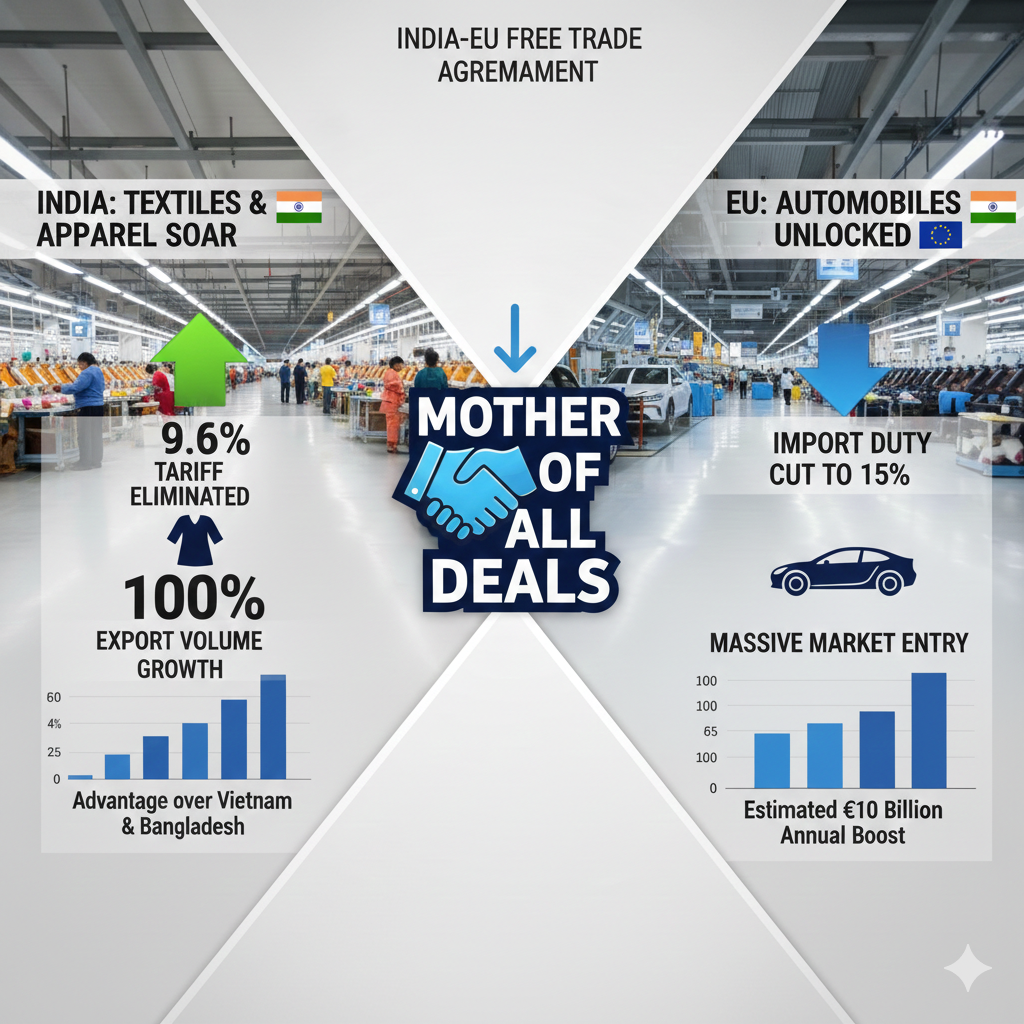
Textiles & Apparel: Removal of the ~10% tariff will help Indian exporters compete with duty-free rivals like Bangladesh and Vietnam.
-
Services & IT: Improved "professional mobility" rules will allow Indian IT experts and consultants easier access to work across all 27 EU member states.
-
Pharmaceuticals: Faster regulatory approvals for India’s massive generic drug industry.
Key Wins for the EU
-
Automobiles: Drastic cuts to India's high import duties (currently up to 100%) on European cars.
-
Wines & Spirits: Lowering of the steep "sin taxes" that have long hampered European luxury exports.
-
High-Tech Machinery: Preferential access to India’s booming infrastructure and manufacturing sectors.
Comparison: The Economic Impact
| Sector | Current Barrier | Proposed Change | Potential Impact |
| Textiles | 9.6% - 12% Tariff | 0% | Export volumes expected to double |
| Luxury Cars | 70% - 100% Duty | Slashing to ~15-30% | Massive entry for EU automakers |
| IT Services | Complex Visa Rules | Simplified Mobility | Multi-billion dollar growth in services |
| Pharma | Long approval delays | Mutual recognition | India as "Pharmacy of Europe" |
Remaining Hurdles: CBAM and GSP
Despite the optimism, two major "elephants in the room" remain:
-
CBAM (Carbon Tax): India is pushing for exemptions from the EU’s Carbon Border Adjustment Mechanism, which threatens to impose a "green tax" on Indian steel and aluminum.
-
GSP Suspension: From January 1, 2026, the EU suspended Generalised Scheme of Preferences (GSP) benefits for 87% of Indian goods. This has created a "tariff cliff" that only the final FTA can bridge.
Verified Sources for Reference:
-
The Economic Times: Mother of all trade deals is loading—What it means for India
-
The Hindu: Piyush Goyal calls India-EU FTA the 'Mother of All Deals'
-
Times of India: India-EU FTA nearing completion amid Trump tariff uncertainty
-
Chatham House: EU and India seek closer relations as Trump upends global order
