


The Future of Smart Stitching: AI in Embroidery Machine Technology
You sit at your embroidery machine, watching the needle dance across the fabric. The design takes shape exactly as you imagined. The thread tension is perfect. The colors blend seamlessly. And you did not have to manually adjust a single setting. This is not a fantasy. This is the direction embroidery technology is heading right now. Artificial intelligence is moving from science fiction into your sewing room, and it is changing everything about how we create with thread. Understanding the role of Ai in Embroidery Machine technology helps you prepare for a future where machines become creative partners rather than just tools.
The shift is already happening. Some of it you can see in machines available today. Some of it lives in research labs, pushing boundaries of what embroidery can even mean. Let us explore where we are and where we are going.
The Intelligent Machine: AI at the Hardware Level
Walk into a dealership today, and you might already find machines with AI capabilities hiding in plain sight. The PFAFF creative icon 2, winner of the Red Dot Design Award, embeds artificial intelligence in ways that feel almost magical .
An AI works silently in the background while you sew. It helps with practical tasks like attaching the presser foot correctly, eliminating the guesswork that trips up beginners and annoys experienced sewists . Voice recognition lets you control the machine hands-free. Imagine saying "Alexa, switch to embroidery mode" while your hands hold fabric in place . That is not convenience. That is a fundamental shift in how you interact with your machine.
The built-in camera scans your hooped fabric and displays it on the color touchscreen . This lets you position designs precisely without guesswork or wasted material. The machine sees what you see and helps you make better decisions.
Other manufacturers are following similar paths. Brother's 2026 lineup includes machines like the PR1060W with ten needles and speeds up to 1000 stitches per minute, plus virtual design previews that help avoid costly mistakes before you stitch . The Celeste CX1e connects wirelessly with the Artspira creative app, letting you send designs straight from your smart device to the machine . These are early steps toward fully connected, intelligent embroidery ecosystems.
Research from Jack Technology shows where this is heading. The company has already released the "Aitu" high-end AI sewing machine and demonstrated a humanoid robot prototype combining AI vision with intelligent fabric handling . That robot is expected to reach the market in late 2026 . We are not decades away from robotic embroidery assistants. We are months away.
Software That Thinks Like a Digitizer
Hardware gets the attention, but software is where AI truly transforms embroidery. The days of manual digitizing as the only path to quality may be numbered.
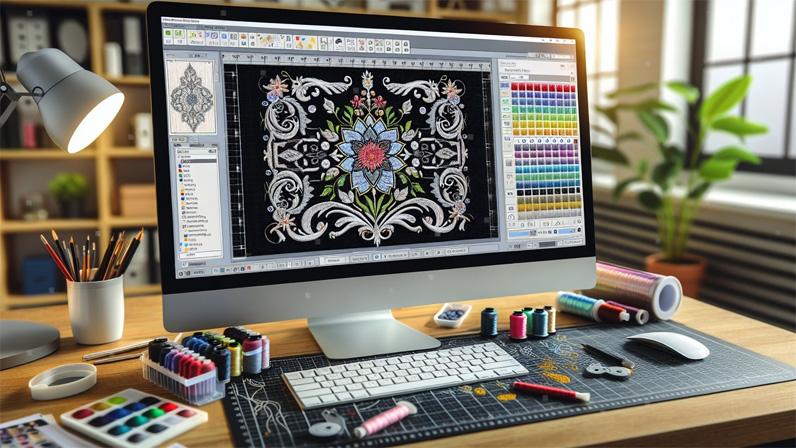
Wilcom EmbroideryStudio 2026 introduced what they call an "industry first" with their Multi Blend tool, which seamlessly blends stitch types and colors across multiple layers . This is the kind of complex decision-making that used to require years of digitizing experience. Now software handles it automatically.
More significantly, Wilcom added "Answers," an embedded AI assistant that delivers instant help within the software . When you get stuck on a technique or need guidance, you ask the AI rather than searching through manuals or forums. This democratizes professional digitizing, making expert knowledge available to everyone.
The software landscape in 2026 offers options at every level. Wilcom EmbroideryStudio leads for commercial pros with features like Multi Blend, precision grids, and auto-digitizing . Hatch delivers photorealistic previews for apparel businesses. Free tools like Ink/Stitch serve hobbyists . And Style3D integration adds 3D fabric simulations that let you preview drape and behavior before stitching a single thread .
What all these tools share is a move toward automation of complex decisions. AI predicts stitch flaws, optimizes patterns, and detects errors before they waste thread and fabric . The software learns from thousands of successful designs and applies that knowledge to your project.
Brother's new BE Embroidery Studio software promises advanced design tools, seamless CorelDRAW integration, and smoother Auto Punch results with minimal editing . No dongle required. Just activate and start designing. The barriers to entry keep falling.
Beyond Decoration: AI Enables New Possibilities
Here is where things get really interesting. AI is not just making traditional embroidery easier. It is enabling entirely new types of embroidery we could not do before.
Researchers at Cornell Tech and the University of Tokyo developed OriStitch, a computational fabrication workflow that turns flat fabrics into self-folding 3D structures . You embroider specific patterns using functional threads, then apply heat, and the fabric folds itself into a target shape. Think self-assembling handbags, caps, or even vase covers made from ordinary denim or leather .
The team created a tool that automatically converts 3D meshes into 2D stitch patterns . Their system successfully handled models with up to 338 hinges in a single design. This is not embroidery as decoration. This is embroidery as engineering, as construction, as manufacturing.
In the heritage space, researchers are using diffusion models to generate Cantonese embroidery-style images with hundreds of labeled samples . This addresses a critical need: preserving traditional techniques that only a few living masters still practice. By training AI on existing embroidery, they can generate new designs that capture the unique textures, stitch patterns, and color combinations of this intangible cultural heritage .
The technology combines lightweight LoRA fine-tuning for texture reproduction, SAM semantic segmentation for spatial constraints, and ControlNet for accurate structure-color restoration . The results outperform existing methods on key metrics while enabling applications from relic restoration to intelligent manufacturing simulation.
The Human-Machine Partnership
With all this talk of AI and automation, you might wonder where human creativity fits. The answer, according to design experts, is at the center.
The Heimtextil Trends 2026 report, developed by Milan-based design platform Alcova, carries the provocative title "Craft is a verb" . Their research explores how artificial intelligence and traditional craftsmanship can work together rather than compete. One trend direction they identify is "Visible Co-Work," where humans and AI collaborate on projects to create digitally embroidered linen or 3D-knitted patchwork .
Joseph Grima from Alcova puts it plainly: "Design should be original and surprising; it should create meaning. This is something that AI cannot do, nor can it act intuitively" . The machine handles execution, optimization, and technical precision. The human brings intuition, meaning, and surprise.
This partnership shows up in other trend directions too. "Re: Media" explores the back-and-forth between hand drawings and digital renderings, with motifs based on glitches and pixelated color blends . "Sensing Nature" uses AI to record natural phenomena like sea motion or tree bark textures and translate them into patterns . The technology extends human perception and capability rather than replacing it.
Practical Implications for Today's Embroiderers
What does all this mean for you right now? Let us get practical.
If you are shopping for a new machine, look beyond stitch count and hoop size. Consider which models offer AI-assisted features that will save you time and frustration . Adaptive tension sensors that adjust hundreds of times per second based on fabric resistance. Laser-guided hoop alignment that cuts hooping time by over 60 percent. Direct cloud sync that eliminates USB cable clutter .
For software, consider whether AI-assisted digitizing fits your workflow. The 2026 tools from Wilcom and others offer features that were unavailable just a year ago . Free trials let you test drive these capabilities before committing.
And for your creative practice, start thinking about embroidery as more than just decoration. The techniques emerging from research labs will eventually trickle down to consumer machines. Self-folding fabrics, intelligent texture generation, and robotic assistance are coming. The embroiderers who thrive will be those who see AI as a collaborator rather than a threat.
Challenges and Considerations
The road ahead is not entirely smooth. Current deep learning-based embroidery simulation methods still face challenges: simplistic textures that lack diversity, color shift from original images, structural distortion, and heavy reliance on large training datasets . Researchers are actively working on these problems, but perfection remains elusive.
There is also the question of access. Professional-grade AI features currently live in higher-end machines and premium software . As with any technology, early adoption costs more. But prices will come down, and features will trickle to mid-range options over time.
And finally, there is the human factor. Learning to work with AI requires new skills. You need to understand what the technology does well and where it falls short. You need to provide clear direction and meaningful feedback. The machine becomes a partner, but you remain the designer.
Conclusion
The future of smart stitching is already arriving. AI in embroidery machine technology is transforming how we create, from hardware that anticipates our needs to software that makes professional digitizing accessible to everyone. Research labs are pushing embroidery beyond decoration into engineering, preservation, and entirely new forms of expression.
Yet through all this change, human creativity remains essential. The machine handles technical precision. We bring intuition, meaning, and surprise. The partnership between craft and code opens possibilities neither could achieve alone.
Whether you are a hobbyist stitching for joy or a business owner producing client work, the message is the same. Embrace these tools as they become available. Learn to work with AI rather than against it. And keep creating. The needle still dances. It just has a smarter partner now.
