


Research Paper Manuscript: Structure and Writing Tips
| According to The Journal Publications, “You must be aware that the acceptance rates in top journals are usually less than 10%.” |
Indeed, writing a manuscript for your research paper can be an overwhelming process, but it is genuinely worth your efforts. Many peers often submit their manuscripts to top journals, but get rejected due to a lack of credibility and unprofessional manuscripts. Thus, they feel demotivated. When I was writing my manuscript, it was rejected many times. However, due to my passion and dedication, my research paper was successfully published. Since then, I have published a total of 6 research papers.
Are you also beginning to write your very first manuscript? That’s such a great thing! However, it is essential to seek an expert’s guidance before you start your writing.
As someone with experience in writing and publishing research papers, I will help you understand the structure of a manuscript, along with some writing tips.
So, are you ready? Let’s start our guide!
What is a Manuscript of a Research Paper?
Firstly, let’s begin our discussion by understanding what a manuscript of a research paper actually is.
A manuscript is basically a written document that you have to submit to a journal or a publisher as a draft. Additionally, it allows you to discuss your unique ideas and present your findings to your potential audience. Besides that, your manuscript undergoes a peer review process where experts decide whether your research meets the criteria of their journal or not. This is the point where the majority of manuscripts are rejected. However, to avoid the rejection of your manuscript, your research must be credible and follow the guidelines of the journal.
Now that you have a clear idea of the manuscript for a research paper, let’s understand its structure.
How to Structure your Manuscript?
For my first successfully published research paper, I had sought help with manuscript writing from a professional. After that, I became familiar with the structure of a manuscript, and then I wrote all of my other research papers without any help.
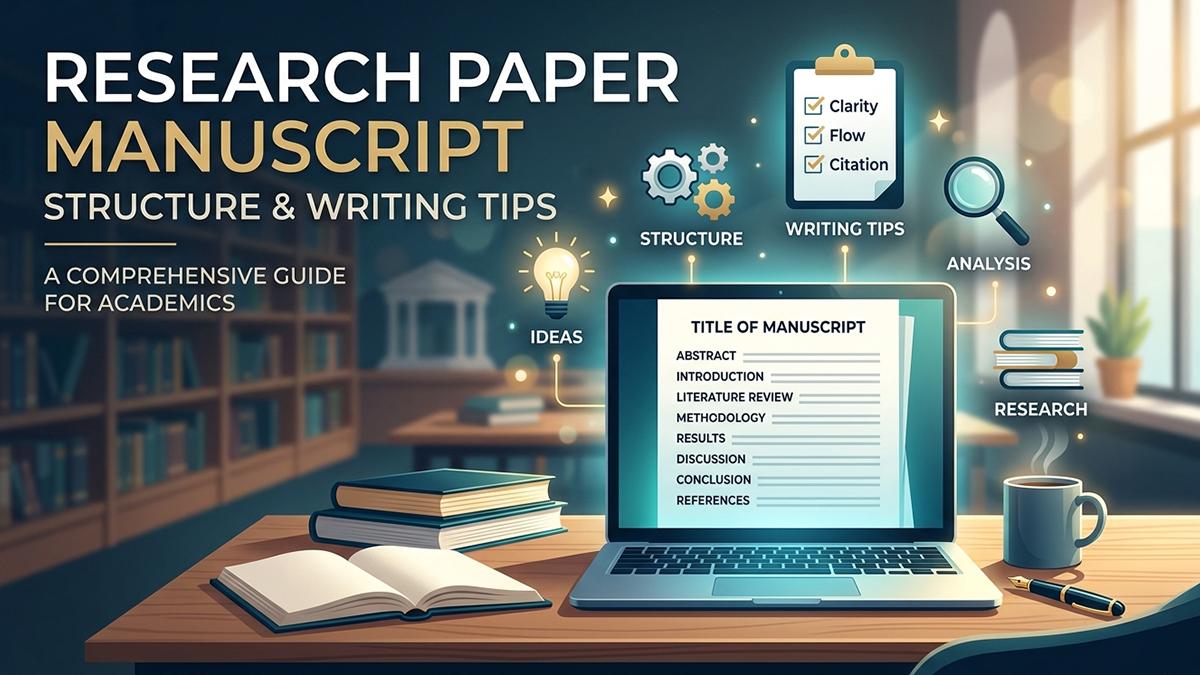
To write a dissertation, you must follow a standard structure which includes: Title, Abstract, Introduction, Methods, Results, Conclusion, Acknowledgement, and References.
Title:
Firstly, you must choose a compelling title for your research that allows you to grab the reader’s attention. One common thing that I noticed inmy rejected manuscripts was that I had chosen irrelevant or too common titles that would not capture the reader’s interest. Thus, it is crucial to select a gripping title, as journals may also reject your manuscript just by reading your poorly chosen title.
Abstract:
In addition to this, write an abstract that is a summary of your research paper. The abstract allows you to briefly introduce the concept of your research and discuss its significance in society.
Introduction:
Moreover, include an introduction in which you will discuss the main purpose of your research. Additionally, mention why you carry out this research, and also state your main research questions.
Methods and Materials:
Besides that, you must also include how you conduct your research and what tools and materials you used for that research. You must ensure that every methodology that you discuss in this section is clear to your readers. Another mistake I made in my rejected research papers was not providing a clear explanation of the methods and materials that I used in my research. Due to his mistake, my research paper was not relevant and was thus rejected.
Results:
Furthermore, add the findings and data to discuss the results of your research. You must also include stats, tables, and figures so that the results are clear to the readers. Moreover, these stats, tables, and figures also boost the credibility of your research, enhancing the chance of the acceptance of your manuscript.
Conclusion:
After the results, write a conclusion of your research. In this section, you will conclude what you have discussed in your research paper. However, you can also give your personal opinions in the conclusion, but remember to provide evidence-based thoughts. To ensure that your opinion speaks with credibility, you can use caution phrases like “the evidence shows,” “this data indicates,” and “this research suggests.”
Acknowledgement:
Although this is an optional section, you must thank the people who have helped you with your research.
Reference List:
Finally, add a reference list of the sources that you have mentioned in your sources. For my first research paper, I didn’t add the reference list, so my manuscript was detected as plagiarized. Then one of my seniors told me that a reference list is crucial for a research paper to avoid any plagiarism.
Tips to Write your Manuscript
I hope that you have understood the structure of a manuscript clearly. Now, let’s discuss how to write an exceptional manuscript.
To write a manuscript, you must be aware of some essential tips and tricks, as they will help you stand out from other researchers. However, ensure that you first write a draft and then rewrite it after completing and checking the entire draft. The following are some tips on how to write an articulated manuscript:
Read the Journal’s Guidelines:
The very first thing you must do is to choose a journal. Once you have decided on the journal, read its guidance. This will enable you to ensure that your research paper is based on the style and format of that journal. Moreover, many journals only accept manuscripts with a specific style and format. Hence, choosing a journal before starting your research allows you to write your research according to its preferences, boosting your chances of acceptance.
Ensure that your Content is Relevant to the Title:
Additionally, ensure that you are writing the content of your manuscript that is relevant to the chosen title, as it will enhance the credibility of your research paper. Also, make sure to include these things in your writing:
- A formal language with no slangs
- Neutral and unbiased tone
- Don’t use contractions
This will boost the quality of your research paper, making it suitable for readers.
Proofread and Edit:
Finally, don’t forget to proofread and edit your manuscript and eliminate all errors from it, and enhance its readability. Once you review and edit your draft, rewrite it and submit it for publication.
However, if you are not aware of the publishing process, you can seek research paper publishing services from professionals. Additionally, you can also take a look at How To Publish Your Research? to get an idea of the publishing process.
Final Words!
To conclude, for an exceptional research paper, it is vital to be aware of the structure and writing criteria of your manuscript that meet the demands of your chosen journal. To ensure that your manuscript is well-written, follow this guide.
I hope that this blog will be helpful for you to understand the structure and writing of a manuscript. Best of luck with your research paper publication!
