


AI Reception Agents vs Human Receptionists: Which Is Better for Modern Businesses?
Introduction
The way businesses communicate with customers has changed dramatically over the last decade. Customers no longer judge a company solely on the quality of its products or services. Instead, they evaluate the entire experience-from the moment they visit a website to the first phone call they make. In many cases, that first interaction determines whether a potential customer becomes a loyal client or moves on to a competitor.
For years, human receptionists have been the face and voice of businesses. They answer calls, schedule appointments, direct inquiries, and create first impressions that shape customer perceptions. Their ability to communicate naturally and build relationships has made them an essential part of business operations across industries such as healthcare, legal services, hospitality, real estate, and professional consulting.
However, customer expectations are evolving faster than ever. Today's consumers expect immediate responses, personalized interactions, and support outside traditional business hours. They are less willing to wait on hold, leave voicemails, or navigate complicated phone systems. In a world where convenience influences buying decisions, responsiveness has become a competitive advantage.
This shift has given rise to a new generation of communication technology: AI Reception Agents. Powered by artificial intelligence, natural language processing, and machine learning, these virtual receptionists are designed to handle customer inquiries, schedule appointments, answer questions, and provide support 24/7.
As more organizations explore AI-driven solutions, a common question emerges: Are AI Reception Agents better than human receptionists?
The answer is not as simple as choosing one over the other. Both have unique strengths, limitations, and use cases. Understanding how they compare can help businesses make informed decisions about customer communication strategies and identify the right balance between technology and human interaction.
The Value Human Receptionists Bring to a Business
Human receptionists have long been the cornerstone of customer communication. Their role extends far beyond answering phones or greeting visitors. They often serve as the first point of contact between a business and its customers, influencing perceptions before any product or service is discussed.
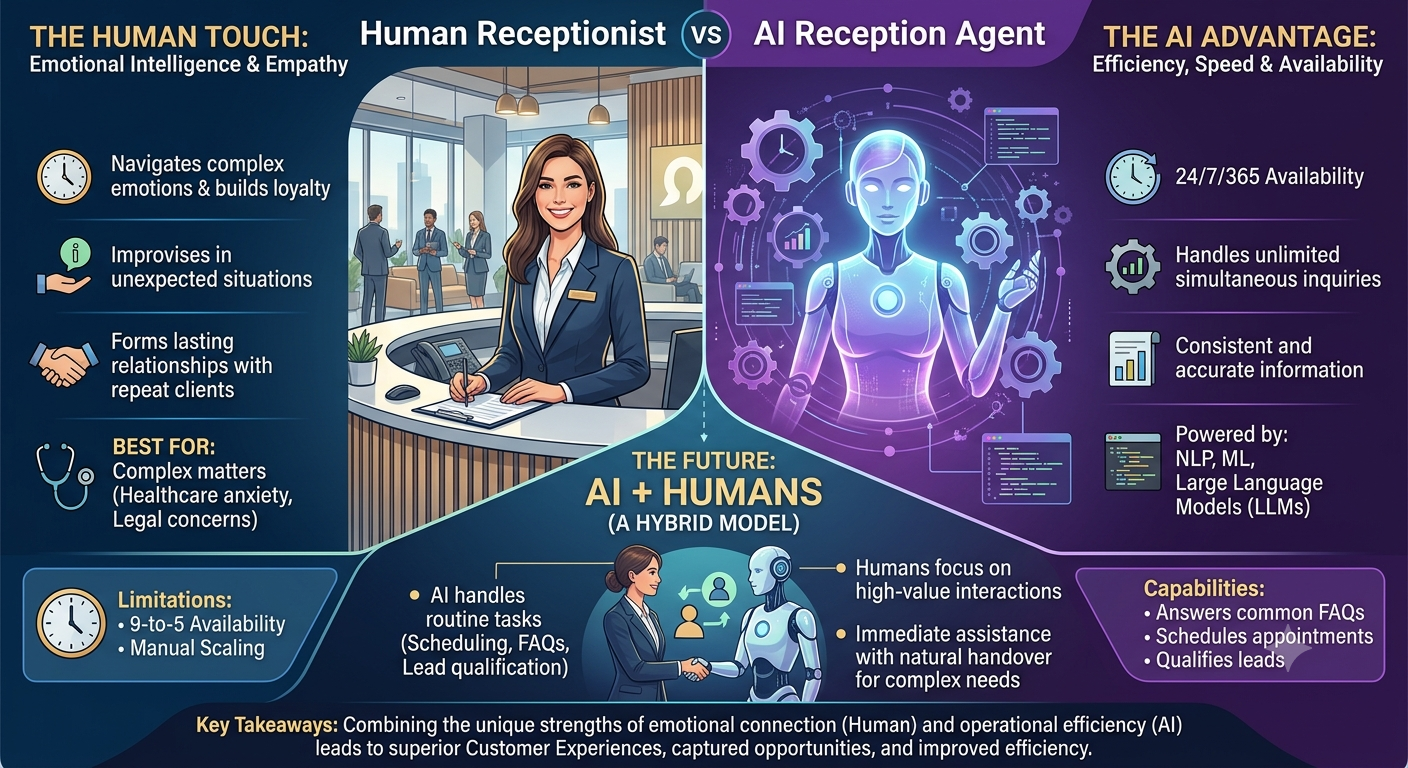
One of the greatest advantages of human receptionists is their emotional intelligence. They can recognize tone, urgency, frustration, excitement, and uncertainty in a way that feels natural and instinctive. This ability allows them to adapt their communication style based on the situation.
Consider a healthcare clinic receiving a call from a concerned patient. A skilled receptionist can provide reassurance, listen attentively, and respond with empathy. Similarly, a law firm handling sensitive client matters benefits from a receptionist who can navigate emotional conversations with professionalism and understanding.
Human receptionists are also capable of critical thinking and improvisation. Customers do not always ask straightforward questions, and unexpected situations arise regularly. Experienced receptionists can interpret context, ask follow-up questions, and make decisions that align with business objectives.
Relationship building is another significant strength. Many businesses value the personal connections that receptionists develop with repeat customers. Familiar voices and personalized interactions contribute to customer loyalty and satisfaction.
Despite these advantages, relying exclusively on human receptionists presents challenges—particularly as customer expectations continue to increase.
The Limitations of Traditional Reception Systems
While human receptionists excel in many areas, they face practical constraints that technology does not.
The most obvious limitation is availability. Receptionists typically work during business hours, which means inquiries outside those hours often go unanswered. For businesses serving customers across multiple time zones or operating in highly competitive industries, missed calls can translate directly into lost revenue.
Scalability presents another challenge. A receptionist can only handle a limited number of conversations at one time. During busy periods, incoming calls may exceed capacity, resulting in long hold times, unanswered calls, or rushed interactions.
Cost is also a consideration. Hiring, training, and retaining qualified reception staff requires a significant investment. Businesses that require extended coverage often need multiple employees, increasing operational expenses even further.
Consistency can be difficult to maintain as well. Human performance naturally varies based on workload, stress levels, and other factors. Even highly skilled employees can become overwhelmed during peak periods.
These challenges do not diminish the value of human receptionists, but they do highlight areas where technology can provide meaningful support.
What Are AI Reception Agents?
AI Reception Agents are intelligent virtual assistants designed to manage customer interactions through voice, chat, SMS, and other communication channels. Unlike traditional automated systems that rely on rigid menus and scripted responses, modern AI agents can understand natural language and engage in conversational interactions.
Using technologies such as natural language processing (NLP), machine learning, and large language models, AI Reception Agents can interpret customer intent, answer questions, schedule appointments, route inquiries, and collect information in real time.
Imagine a customer calling a dental clinic after business hours. Instead of reaching voicemail, they are greeted by an AI Reception Agent capable of answering questions about services, checking appointment availability, and booking a consultation instantly.
Similarly, a real estate agency can use an AI Reception Agent to respond to property inquiries, schedule viewings, and qualify leads without requiring immediate staff involvement.
These systems are designed not only to automate tasks but also to improve customer experiences by eliminating delays and ensuring consistent communication.
What makes AI Reception Agents particularly appealing is their ability to operate continuously. They do not require breaks, vacations, or shifts. They can handle multiple conversations simultaneously and provide support around the clock.
This capability is transforming how businesses think about customer communication.
AI Reception Agents vs Human Receptionists: A Detailed Comparison
When comparing AI Reception Agents and human receptionists, it is important to evaluate them across several key areas that directly impact business performance.
Availability
Human receptionists are limited by working hours. While businesses can extend coverage through additional staffing, doing so increases costs significantly.
AI Reception Agents operate 24 hours a day, seven days a week. Customers can receive assistance at any time, ensuring inquiries are addressed immediately regardless of when they occur.
For businesses that receive inquiries outside normal operating hours, this advantage alone can justify implementation.
Cost Efficiency
Employing reception staff involves salaries, benefits, training costs, and ongoing management. As businesses grow, communication demands often require additional personnel.
AI Reception Agents can manage large volumes of inquiries without proportional increases in operating expenses. While there is an initial investment in implementation, many organizations realize significant long-term savings.
Scalability
A human receptionist can manage only one conversation at a time. During peak periods, customers may experience delays.
AI systems can handle multiple inquiries simultaneously without sacrificing response speed. This scalability makes them particularly valuable for growing businesses.
Accuracy and Consistency
Human errors are inevitable. Information may be forgotten, messages may be recorded incorrectly, or details may be overlooked during busy periods.
AI Reception Agents provide consistent responses based on predefined business information and workflows. This consistency helps maintain service quality across all interactions.
At this point, many organizations begin exploring AI Reception Agent Development as a strategic investment rather than simply a cost-saving measure. By implementing intelligent communication systems, businesses can create more responsive customer experiences while improving operational efficiency.
Customer Experience
This category is more nuanced.
Human receptionists excel in emotionally complex situations that require empathy, judgment, and relationship building.
AI Reception Agents excel in speed, convenience, and accessibility.
The best customer experience often comes from combining both strengths rather than viewing them as competing alternatives.
Why the Future Is Not AI vs Humans-It's AI Plus Humans
One of the biggest misconceptions about artificial intelligence is that it exists to replace people. In reality, the most successful implementations focus on augmentation rather than replacement.
Businesses are increasingly adopting hybrid communication models where AI handles routine inquiries and administrative tasks while human employees focus on complex interactions.
For example, an AI Reception Agent might answer common questions, schedule appointments, collect customer information, and qualify leads. Once a conversation requires specialized expertise or emotional sensitivity, the inquiry can be transferred seamlessly to a human team member.
This approach creates the best of both worlds.
Customers receive immediate assistance without sacrificing the personal touch that human interactions provide. Employees spend less time on repetitive tasks and more time on activities that create value.
Rather than competing against human receptionists, AI often enhances their effectiveness.
Conclusion
The debate between AI Reception Agents and human receptionists is not about determining a single winner. Both play important roles in modern business communication.
Human receptionists bring empathy, relationship-building skills, and adaptability that remain difficult to replicate. AI Reception Agents provide speed, scalability, consistency, and around-the-clock availability that traditional reception systems cannot match.
For many organizations, the most effective strategy is not choosing one over the other but combining both into a unified customer communication system.
As customer expectations continue to evolve, businesses that embrace intelligent communication solutions will be better positioned to improve customer experiences, capture more opportunities, and remain competitive in an increasingly digital marketplace.
Frequently Asked Questions
What is an AI Reception Agent?
An AI Reception Agent is a virtual assistant powered by artificial intelligence that can answer calls, respond to inquiries, schedule appointments, qualify leads, and assist customers through natural conversations.
Are AI Reception Agents better than human receptionists?
Not necessarily. AI Reception Agents excel in availability, speed, and scalability, while human receptionists provide emotional intelligence, empathy, and relationship-building skills. Many businesses achieve the best results through a combination of both.
Can AI Reception Agents answer calls 24/7?
Yes. One of the biggest advantages of AI Reception Agents is their ability to provide support around the clock without interruptions.
Do customers know they are speaking with AI?
Modern AI systems are highly conversational. While transparency is important, many interactions feel natural enough that customers focus more on receiving help than on whether the response comes from AI or a human.
Which industries benefit most from AI Reception Agents?
Healthcare, legal services, real estate, hospitality, financial services, and home service businesses are among the industries seeing significant benefits from AI-powered reception systems.
Can AI Reception Agents schedule appointments?
Yes. Many solutions integrate directly with calendars, CRM platforms, and scheduling systems to automate appointment booking and management.
Is AI Reception Agent technology secure?
When implemented properly, AI systems can include encryption, secure data handling practices, access controls, and compliance measures to protect sensitive information.
How much does an AI Reception Agent cost?
Costs vary depending on customization, integrations, communication channels, and business requirements. Custom solutions typically provide greater flexibility and long-term value.
Can AI Reception Agents qualify leads?
Yes. AI systems can collect customer information, ask qualifying questions, and route high-value prospects to the appropriate team members.
What is the future of AI Reception Agents?
As artificial intelligence continues to evolve, AI Reception Agents will become increasingly capable of handling complex conversations, personalizing interactions, and supporting business operations at a deeper level.
