



Directory
Browse the SeshtaConnect Directory: Find professionals, courses, job listings, and groups. Discover new connections to ignite your career and personal growth.
-
-
 AFB Rapid Culture by MGIT - Tissue / Biopsy New2,000.00₹In stockHyderabad0 ReviewsAn **AFB (Acid-Fast Bacilli) Rapid Culture by MGIT (Tissue/Biopsy)** is a highly specialized, fast-tracked test used to detect live *Mycobacterium tuberculosis* (the bacteria that causes TB) or non-tuberculous mycobacteria (NTM) directly from a tissue sample or biopsy.
Instead of waiting several weeks for traditional solid cultures, this method leverages automated liquid-broth technology to catch infections significantly sooner.
---
### How the Test Works
* **The Technology:** **MGIT** stands for *Mycobacteria Growth Indicator Tube*. The sample is placed into a specialized liquid broth containing a chemical sensor embedded at the bottom of the tube.
* **The Mechanism:** As live mycobacteria grow and consume oxygen in the liquid, a built-in fluorescent sensor detects the drop in oxygen.
* **The Rapid Alert:** An automated incubation system checks the tube every hour. The moment the tube begins to fluoresce under UV light, it triggers a positive signal.
---
### Why Use a Tissue / Biopsy Sample?
While TB is famously known as a lung disease (diagnosed via sputum), it can also manifest as **extrapulmonary tuberculosis**—meaning it can infect the lymph nodes, bones, skin, joints, or internal organs.
When a doctor suspects TB outside of the lungs, they will perform a minor surgical procedure or needle biopsy to collect a small tissue specimen. This tissue is kept sterile (usually in a small amount of saline solution) and rushed to the lab, as swabs are not acceptable for this testing.An **AFB (Acid-Fast Bacilli) Rapid Culture by MGIT (Tissue/Biopsy)** is a highly specialized, fast-tracked test used to detect live *Mycobacterium tuberculosis* (the bacteria that causes TB) or non-tuberculous mycobacteria (NTM) directly from a tissue sample or biopsy. Instead of waiting several weeks for traditional solid cultures, this method leverages automated liquid-broth technology to catch infections significantly sooner. --- ### How the Test Works * **The Technology:** **MGIT** stands for *Mycobacteria Growth Indicator Tube*. The sample is placed into a specialized liquid broth containing a chemical sensor embedded at the bottom of the tube. * **The Mechanism:** As live mycobacteria grow and consume oxygen in the liquid, a built-in fluorescent sensor detects the drop in oxygen. * **The Rapid Alert:** An automated incubation system checks the tube every hour. The moment the tube begins to fluoresce under UV light, it triggers a positive signal. --- ### Why Use a Tissue / Biopsy Sample? While TB is famously known as a lung disease (diagnosed via sputum), it can also manifest as **extrapulmonary tuberculosis**—meaning it can infect the lymph nodes, bones, skin, joints, or internal organs. When a doctor suspects TB outside of the lungs, they will perform a minor surgical procedure or needle biopsy to collect a small tissue specimen. This tissue is kept sterile (usually in a small amount of saline solution) and rushed to the lab, as swabs are not acceptable for this testing.0 Comments 0 Shares 805 Views 0 Reviews -
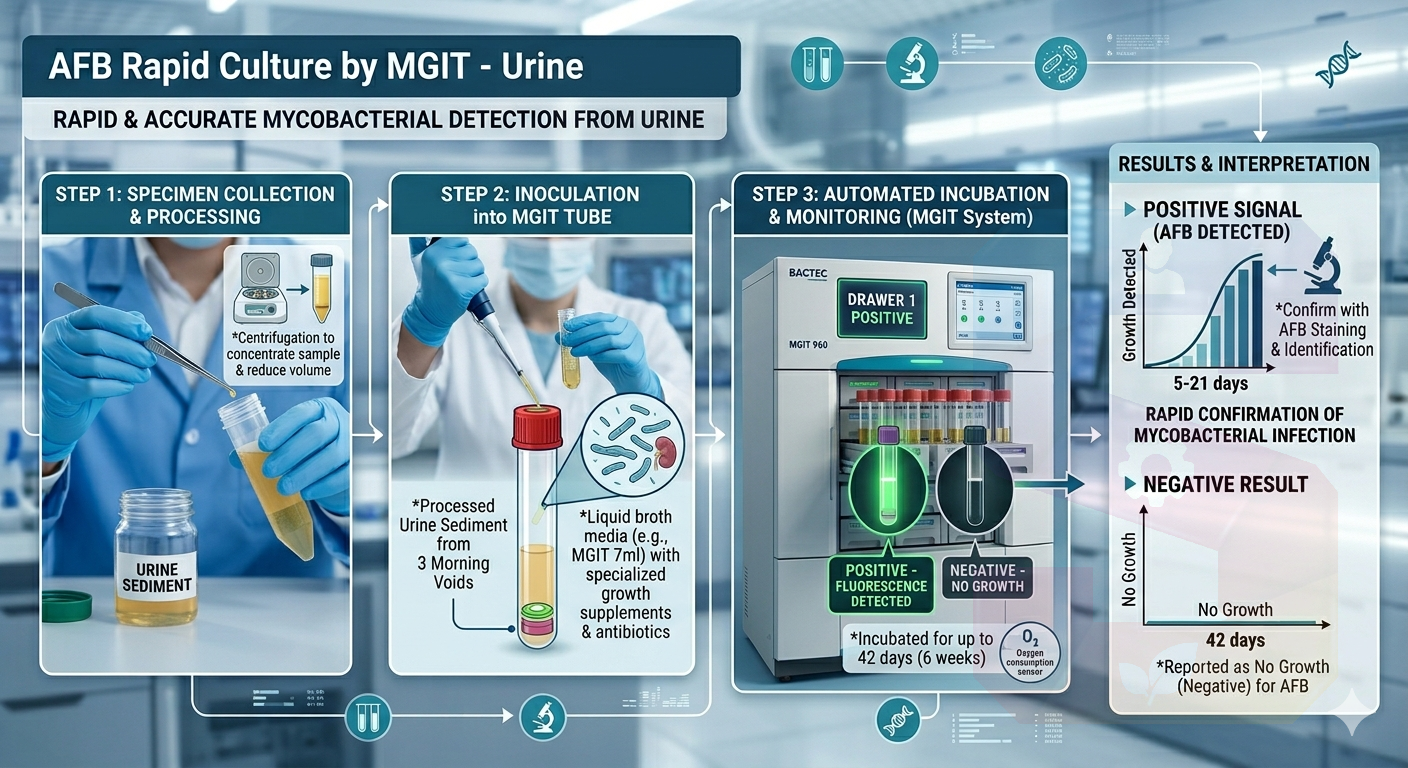 AFB Rapid Culture by MGIT - Urine New2,000.00₹In stockHyderabad0 ReviewsAn **AFB (Acid-Fast Bacilli) Rapid Culture by MGIT (Urine)** is a specialized diagnostic test used to detect live *Mycobacterium tuberculosis* or non-tuberculous mycobacteria (NTM) in the urinary tract.
While tuberculosis is primarily a lung disease, it can spread through the bloodstream to other organs. When it affects the kidneys, prostate, or bladder, it is known as **Genitourinary Tuberculosis (GUTB)**. Because mycobacteria grow incredibly slowly, this automated liquid-culture system is used to fast-track results compared to traditional solid-media methods.
---
### How the Test Works
* **The Sample:** Because the shedding of mycobacteria into urine can be intermittent, doctors typically require **three consecutive days of early-morning, entire-void urine samples**.
* **The Technology:** The processed urine sample is inoculated into a **MGIT** (*Mycobacteria Growth Indicator Tube*) containing a specialized liquid broth.
* **The Detection Mechanism:** At the bottom of the tube is an oxygen-sensitive fluorescent sensor. As live bacteria grow and consume oxygen, the sensor begins to fluoresce. An automated incubator constantly scans the tubes and triggers a positive alert the moment growth is detected.
---
> **Why a Culture is Necessary:**
A routine urinalysis or standard bacterial culture will completely miss mycobacteria. Furthermore, while rapid molecular DNA tests (like PCR) can find the bacteria's genetic material quickly, the **MGIT culture is essential because it proves the bacteria are alive** and allows doctors to test exactly which medications will kill the specific strain.An **AFB (Acid-Fast Bacilli) Rapid Culture by MGIT (Urine)** is a specialized diagnostic test used to detect live *Mycobacterium tuberculosis* or non-tuberculous mycobacteria (NTM) in the urinary tract. While tuberculosis is primarily a lung disease, it can spread through the bloodstream to other organs. When it affects the kidneys, prostate, or bladder, it is known as **Genitourinary Tuberculosis (GUTB)**. Because mycobacteria grow incredibly slowly, this automated liquid-culture system is used to fast-track results compared to traditional solid-media methods. --- ### How the Test Works * **The Sample:** Because the shedding of mycobacteria into urine can be intermittent, doctors typically require **three consecutive days of early-morning, entire-void urine samples**. * **The Technology:** The processed urine sample is inoculated into a **MGIT** (*Mycobacteria Growth Indicator Tube*) containing a specialized liquid broth. * **The Detection Mechanism:** At the bottom of the tube is an oxygen-sensitive fluorescent sensor. As live bacteria grow and consume oxygen, the sensor begins to fluoresce. An automated incubator constantly scans the tubes and triggers a positive alert the moment growth is detected. --- > **Why a Culture is Necessary:** A routine urinalysis or standard bacterial culture will completely miss mycobacteria. Furthermore, while rapid molecular DNA tests (like PCR) can find the bacteria's genetic material quickly, the **MGIT culture is essential because it proves the bacteria are alive** and allows doctors to test exactly which medications will kill the specific strain.0 Comments 0 Shares 878 Views 0 Reviews -
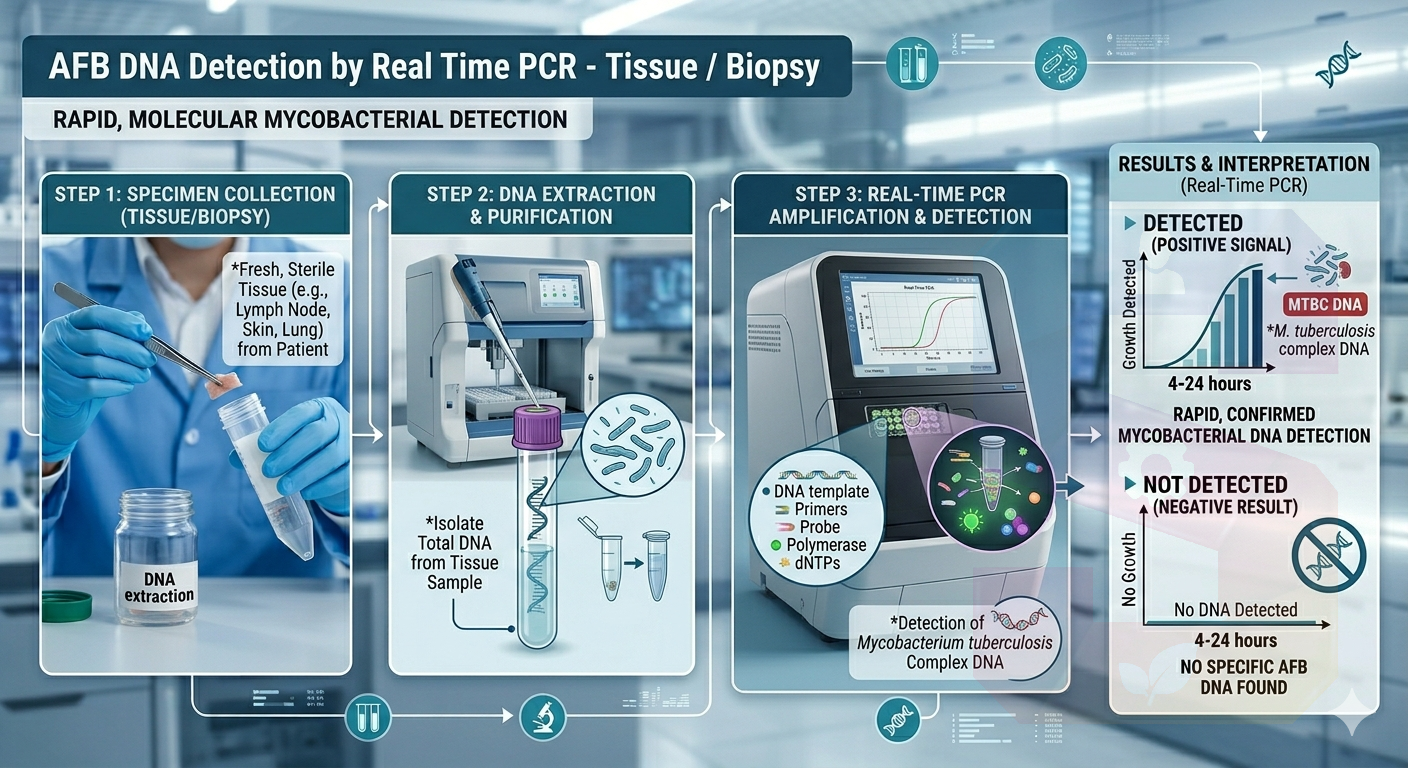 AFB - detection of DNA by Real time PCR tissue and Biopsy New2,700.00₹In stockHyderabad0 ReviewsAn **AFB (Acid-Fast Bacilli) Detection of DNA by Real-Time PCR (Tissue/Biopsy)** is a highly precise molecular diagnostic test used to rapidly identify *Mycobacterium tuberculosis* complex (MTBC) and other mycobacteria directly from tissue specimens or biopsy samples.
Unlike traditional cultures that require weeks for bacteria to grow, this test looks for the genetic blueprint (DNA) of the bacteria, offering highly accurate results in just a matter of hours.
---
### How the Test Works
* **The Target:** The test utilizes **Real-Time Polymerase Chain Reaction (PCR)** technology to detect specific, highly conserved DNA sequences unique to mycobacteria (such as the *IS6110* or *senX3-regX3* genetic markers for *M. tuberculosis*).
* **Amplification:** The laboratory extracts DNA from the biopsy sample (e.g., lymph node, skin, or bone tissue). If even a tiny fragment of target bacterial DNA is present, the PCR machine replicates it millions of times.
* **Real-Time Monitoring:** Fluorescent dyes attach to the DNA copies as they are being made. A computer monitors this fluorescence in real-time; if the signal crosses a specific threshold, the test is confirmed positive.
---
### Key Advantages of This Test
* **Exceptional Speed:** While an automated MGIT liquid culture takes 1 to 3 weeks to flag a positive result, Real-Time PCR can deliver definitive answers within **24 to 48 hours**.
* **High Sensitivity:** It can detect minute amounts of bacterial DNA, making it incredibly useful for "paucibacillary" samples—tissue biopsies where the number of actual bacterial cells is very low.
* **Detects Dead Bacteria:** Because it looks for DNA rather than live organisms, it can still detect the infection even if the patient has already started taking anti-TB medications.
* **Drug Resistance Detection (Reflex):** Many modern Real-Time PCR assays (like GeneXpert or custom multiplex panels) don't just detect the DNA—they simultaneously check for mutations in genes like *rpoB*, immediately alerting doctors if the strain is resistant to major frontline antibiotics like Rifampicin.An **AFB (Acid-Fast Bacilli) Detection of DNA by Real-Time PCR (Tissue/Biopsy)** is a highly precise molecular diagnostic test used to rapidly identify *Mycobacterium tuberculosis* complex (MTBC) and other mycobacteria directly from tissue specimens or biopsy samples. Unlike traditional cultures that require weeks for bacteria to grow, this test looks for the genetic blueprint (DNA) of the bacteria, offering highly accurate results in just a matter of hours. --- ### How the Test Works * **The Target:** The test utilizes **Real-Time Polymerase Chain Reaction (PCR)** technology to detect specific, highly conserved DNA sequences unique to mycobacteria (such as the *IS6110* or *senX3-regX3* genetic markers for *M. tuberculosis*). * **Amplification:** The laboratory extracts DNA from the biopsy sample (e.g., lymph node, skin, or bone tissue). If even a tiny fragment of target bacterial DNA is present, the PCR machine replicates it millions of times. * **Real-Time Monitoring:** Fluorescent dyes attach to the DNA copies as they are being made. A computer monitors this fluorescence in real-time; if the signal crosses a specific threshold, the test is confirmed positive. --- ### Key Advantages of This Test * **Exceptional Speed:** While an automated MGIT liquid culture takes 1 to 3 weeks to flag a positive result, Real-Time PCR can deliver definitive answers within **24 to 48 hours**. * **High Sensitivity:** It can detect minute amounts of bacterial DNA, making it incredibly useful for "paucibacillary" samples—tissue biopsies where the number of actual bacterial cells is very low. * **Detects Dead Bacteria:** Because it looks for DNA rather than live organisms, it can still detect the infection even if the patient has already started taking anti-TB medications. * **Drug Resistance Detection (Reflex):** Many modern Real-Time PCR assays (like GeneXpert or custom multiplex panels) don't just detect the DNA—they simultaneously check for mutations in genes like *rpoB*, immediately alerting doctors if the strain is resistant to major frontline antibiotics like Rifampicin.0 Comments 0 Shares 1K Views 0 Reviews -
 AFB - detection by smear examination ZN Stain Body Fluids New500.00₹In stockHyderabad0 ReviewsAn **AFB (Acid-Fast Bacilli) Detection by Smear Examination using ZN (Ziehl-Neelsen) Stain for Body Fluids** is a rapid, fundamental diagnostic test used to detect the presence of mycobacteria (such as *Mycobacterium tuberculosis*) in various non-blood bodily fluids.
It is one of the oldest, fastest, and most cost-effective methods available to immediately screen for tuberculosis outside of the lungs (extrapulmonary TB).
---
### How the Test Works
* **The Fluids Tested:** This test can be performed on various sterile body fluids, including **Pleural fluid** (around the lungs), **Cerebrospinal fluid (CSF)** (around the brain/spinal cord), **Ascitic/Peritoneal fluid** (abdominal cavity), **Synovial fluid** (joints), or **Pericardial fluid** (around the heart).
* **Concentration:** Because body fluids often contain a very low concentration of bacteria compared to sputum, the laboratory first spins the fluid in a high-speed centrifuge to concentrate any bacterial cells into a pellet at the bottom.
* **The ZN Staining Process:**
1. A smear of the concentrated fluid is fixed onto a glass slide and stained with a bright red dye called **Carbol Fuchsin**.
2. The slide is gently heated, which allows the dye to penetrate the thick, waxy, lipid-rich cell walls (mycolic acid) characteristic of mycobacteria.
3. The slide is washed with an acid-alcohol solution. Standard bacteria lose their color (decolorize), but mycobacteria resist the acid wash and retain the bright red dye—hence the name **"Acid-Fast"**.
4. A blue counterstain (Methylene Blue) is applied to color the background cells and non-acid-fast debris.An **AFB (Acid-Fast Bacilli) Detection by Smear Examination using ZN (Ziehl-Neelsen) Stain for Body Fluids** is a rapid, fundamental diagnostic test used to detect the presence of mycobacteria (such as *Mycobacterium tuberculosis*) in various non-blood bodily fluids. It is one of the oldest, fastest, and most cost-effective methods available to immediately screen for tuberculosis outside of the lungs (extrapulmonary TB). --- ### How the Test Works * **The Fluids Tested:** This test can be performed on various sterile body fluids, including **Pleural fluid** (around the lungs), **Cerebrospinal fluid (CSF)** (around the brain/spinal cord), **Ascitic/Peritoneal fluid** (abdominal cavity), **Synovial fluid** (joints), or **Pericardial fluid** (around the heart). * **Concentration:** Because body fluids often contain a very low concentration of bacteria compared to sputum, the laboratory first spins the fluid in a high-speed centrifuge to concentrate any bacterial cells into a pellet at the bottom. * **The ZN Staining Process:** 1. A smear of the concentrated fluid is fixed onto a glass slide and stained with a bright red dye called **Carbol Fuchsin**. 2. The slide is gently heated, which allows the dye to penetrate the thick, waxy, lipid-rich cell walls (mycolic acid) characteristic of mycobacteria. 3. The slide is washed with an acid-alcohol solution. Standard bacteria lose their color (decolorize), but mycobacteria resist the acid wash and retain the bright red dye—hence the name **"Acid-Fast"**. 4. A blue counterstain (Methylene Blue) is applied to color the background cells and non-acid-fast debris.0 Comments 0 Shares 934 Views 0 Reviews
