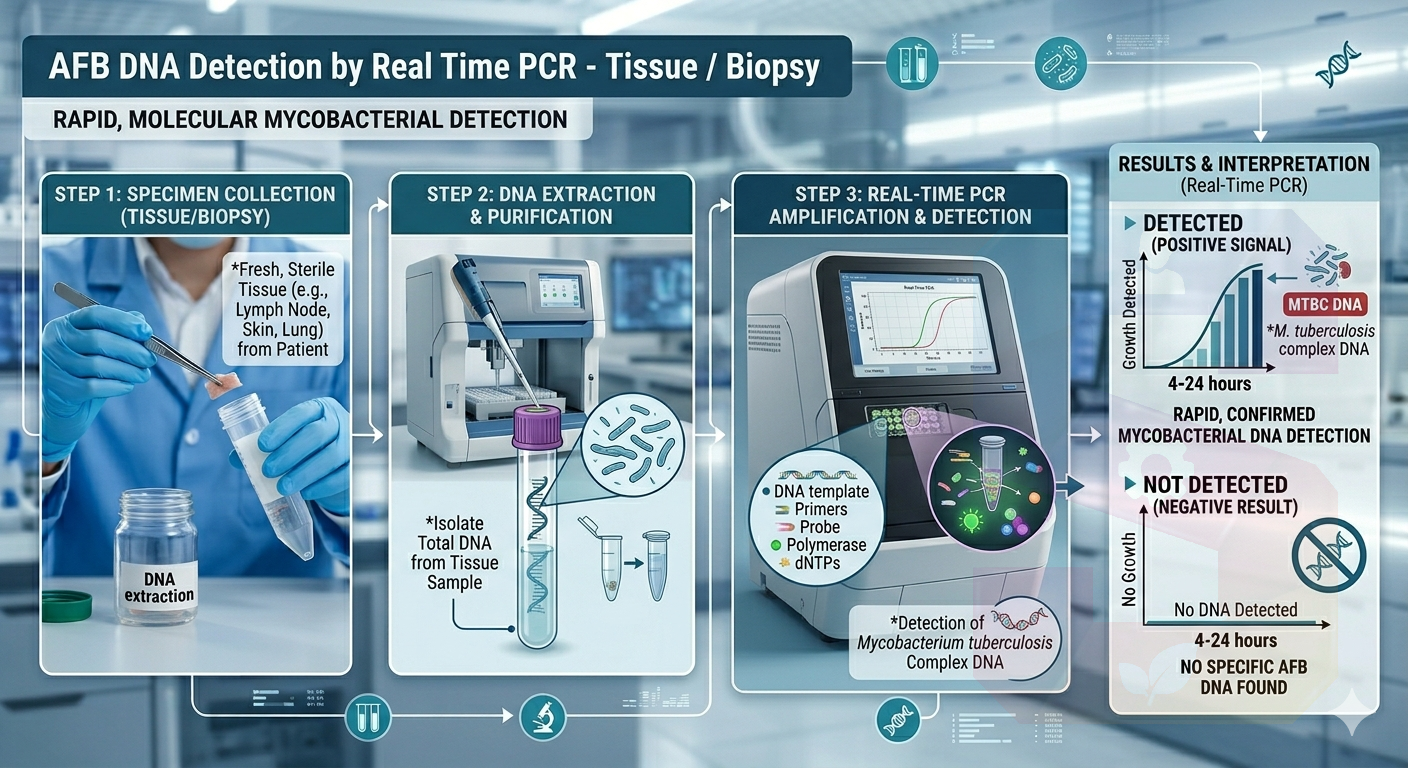
An **AFB (Acid-Fast Bacilli) Detection of DNA by Real-Time PCR (Tissue/Biopsy)** is a highly precise molecular diagnostic test used to rapidly identify *Mycobacterium tuberculosis* complex (MTBC) and other mycobacteria directly from tissue specimens or biopsy samples.
Unlike traditional cultures that require weeks for bacteria to grow, this test looks for the genetic blueprint (DNA) of the bacteria, offering highly accurate results in just a matter of hours.
---
### How the Test Works
* **The Target:** The test utilizes **Real-Time Polymerase Chain Reaction (PCR)** technology to detect specific, highly conserved DNA sequences unique to mycobacteria (such as the *IS6110* or *senX3-regX3* genetic markers for *M. tuberculosis*).
* **Amplification:** The laboratory extracts DNA from the biopsy sample (e.g., lymph node, skin, or bone tissue). If even a tiny fragment of target bacterial DNA is present, the PCR machine replicates it millions of times.
* **Real-Time Monitoring:** Fluorescent dyes attach to the DNA copies as they are being made. A computer monitors this fluorescence in real-time; if the signal crosses a specific threshold, the test is confirmed positive.
---
### Key Advantages of This Test
* **Exceptional Speed:** While an automated MGIT liquid culture takes 1 to 3 weeks to flag a positive result, Real-Time PCR can deliver definitive answers within **24 to 48 hours**.
* **High Sensitivity:** It can detect minute amounts of bacterial DNA, making it incredibly useful for "paucibacillary" samples—tissue biopsies where the number of actual bacterial cells is very low.
* **Detects Dead Bacteria:** Because it looks for DNA rather than live organisms, it can still detect the infection even if the patient has already started taking anti-TB medications.
* **Drug Resistance Detection (Reflex):** Many modern Real-Time PCR assays (like GeneXpert or custom multiplex panels) don't just detect the DNA—they simultaneously check for mutations in genes like *rpoB*, immediately alerting doctors if the strain is resistant to major frontline antibiotics like Rifampicin.
An **AFB (Acid-Fast Bacilli) Detection of DNA by Real-Time PCR (Tissue/Biopsy)** is a highly precise molecular diagnostic test used to rapidly identify *Mycobacterium tuberculosis* complex (MTBC) and other mycobacteria directly from tissue specimens or biopsy samples.
Unlike traditional cultures that require weeks for bacteria to grow, this test looks for the genetic blueprint (DNA) of the bacteria, offering highly accurate results in just a matter of hours.
---
### How the Test Works
* **The Target:** The test utilizes **Real-Time Polymerase Chain Reaction (PCR)** technology to detect specific, highly conserved DNA sequences unique to mycobacteria (such as the *IS6110* or *senX3-regX3* genetic markers for *M. tuberculosis*).
* **Amplification:** The laboratory extracts DNA from the biopsy sample (e.g., lymph node, skin, or bone tissue). If even a tiny fragment of target bacterial DNA is present, the PCR machine replicates it millions of times.
* **Real-Time Monitoring:** Fluorescent dyes attach to the DNA copies as they are being made. A computer monitors this fluorescence in real-time; if the signal crosses a specific threshold, the test is confirmed positive.
---
### Key Advantages of This Test
* **Exceptional Speed:** While an automated MGIT liquid culture takes 1 to 3 weeks to flag a positive result, Real-Time PCR can deliver definitive answers within **24 to 48 hours**.
* **High Sensitivity:** It can detect minute amounts of bacterial DNA, making it incredibly useful for "paucibacillary" samples—tissue biopsies where the number of actual bacterial cells is very low.
* **Detects Dead Bacteria:** Because it looks for DNA rather than live organisms, it can still detect the infection even if the patient has already started taking anti-TB medications.
* **Drug Resistance Detection (Reflex):** Many modern Real-Time PCR assays (like GeneXpert or custom multiplex panels) don't just detect the DNA—they simultaneously check for mutations in genes like *rpoB*, immediately alerting doctors if the strain is resistant to major frontline antibiotics like Rifampicin.