


Sacred Homecoming: Oxford’s Ashmolean Museum Returns 500-Year-Old Stolen Bronze to India
April 25, 2026
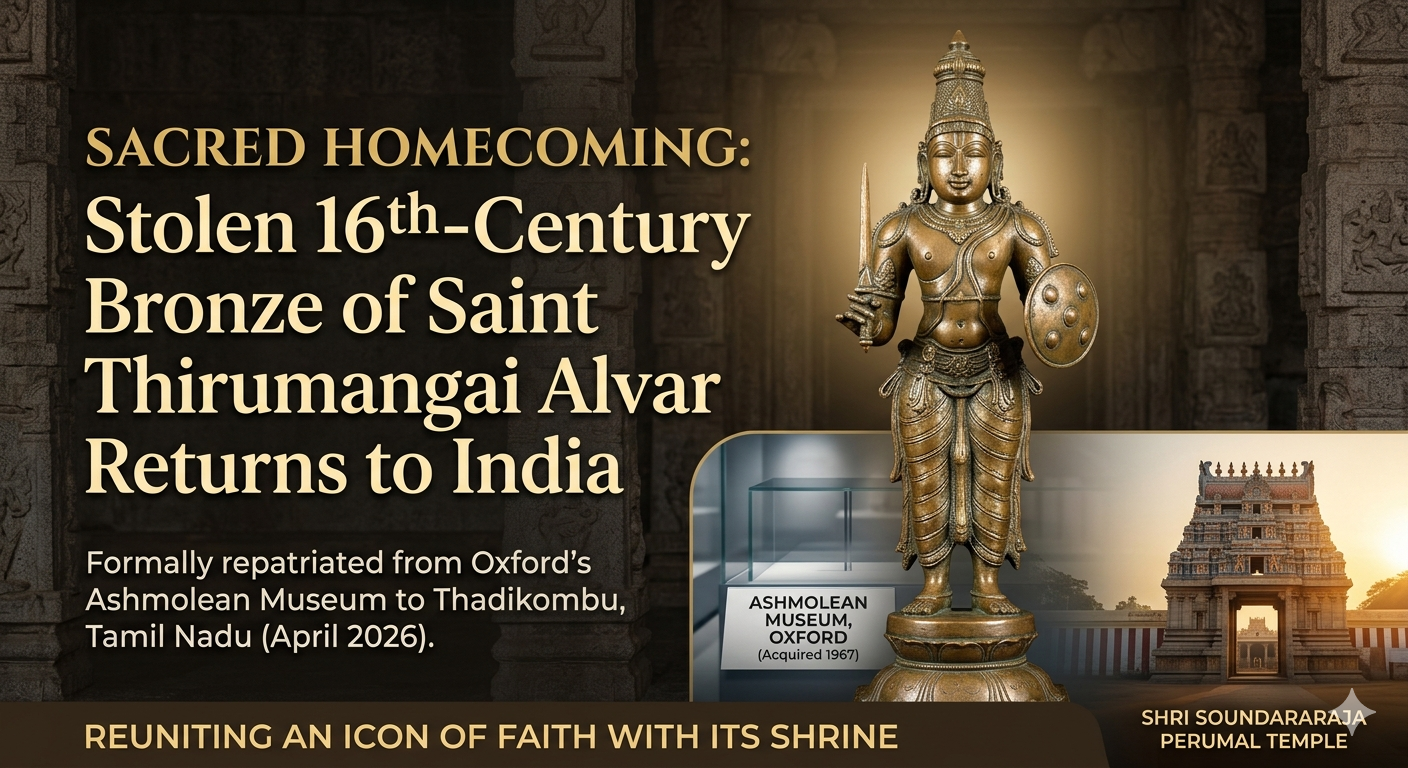
In a significant victory for cultural heritage and international diplomacy, a 16th-century bronze murti of the poet-saint Thirumangai Alvar has officially returned to Indian soil. The artifact, which had been in the possession of Oxford’s Ashmolean Museum for nearly 60 years, was formally handed over following a rigorous investigation into its origins.
The Icon of a Poet-Warrior
The 57.5 cm tall statue depicts Saint Thirumangai Alvar, the last of the twelve celebrated Alvar saints of South India. Known for his legendary transformation from a military chieftain to a prolific devotee of Vishnu, his verses remain a cornerstone of Tamil Vaishnava tradition.
The sculpture is a masterpiece of the Vijayanagara period, characterized by its intricate casting and the spiritual poise of the saint, shown holding a sword and shield—symbols of his warrior past.
A 60-Year Journey of Displacement
The story of the murti’s disappearance reads like a detective novel. It originally belonged to the Shri Soundararaja Perumal Temple in Thadikombu, Tamil Nadu.
-
The Theft: Sometime in the late 1950s or early 1960s, the original bronze was stolen from the temple and replaced with a sophisticated modern replica to avoid detection by devotees.
-
The Sale: In 1967, the Ashmolean Museum purchased the piece at a Sotheby’s auction in London from a private collector, Dr. J.R. Belmont, unaware of its illicit history.
-
The Identification: The breakthrough came in 2019 when scholars and researchers from the India Pride Project matched the museum’s statue with an archival photograph taken in 1957 by the French Institute of Pondicherry. The photo proved the statue was still in the Thadikombu temple years before it appeared on the London auction block.
Proactive Repatriation
Unlike many long-standing legal battles over artifacts, the return of the Thirumangai Alvar bronze was marked by cooperation. Upon being presented with the evidence in late 2019, the Ashmolean Museum proactively contacted the Indian High Commission to initiate discussions.
Following metal analysis and verification by the Archaeological Survey of India (ASI), the University of Oxford’s Council and the UK Charity Commission approved the repatriation.
From Gallery to Garbhagriha
The return has been hailed as a "restoration of faith." During the handover ceremony at the High Commission of India in London, officials emphasized that this was not merely a return of "art," but the return of a living deity to its community.
"This is a momentous day for the devotees of Thadikombu," said a representative for the Tamil Nadu Idol Wing. "The saint will no longer be viewed through a glass case; he will return to his temple to be dressed, worshipped, and carried in procession as he was five centuries ago."
The Search Continues
While the return of the Alvar saint is a cause for celebration, the work is far from over. Archival records suggest that at least three other major icons—including representations of Vishnu and Kaliya Krishna—were stolen from the same temple during the same period. This successful repatriation is expected to serve as a blueprint for the recovery of other treasures currently held in international collections.
#Repatriation #AshmoleanMuseum #ThirumangaiAlvar #TamilNadu #TempleHeritage #CulturalRestoration #IndiaPrideProject
