


The Hidden Crisis: Earth’s Underground Water Reserves in Jeopardy
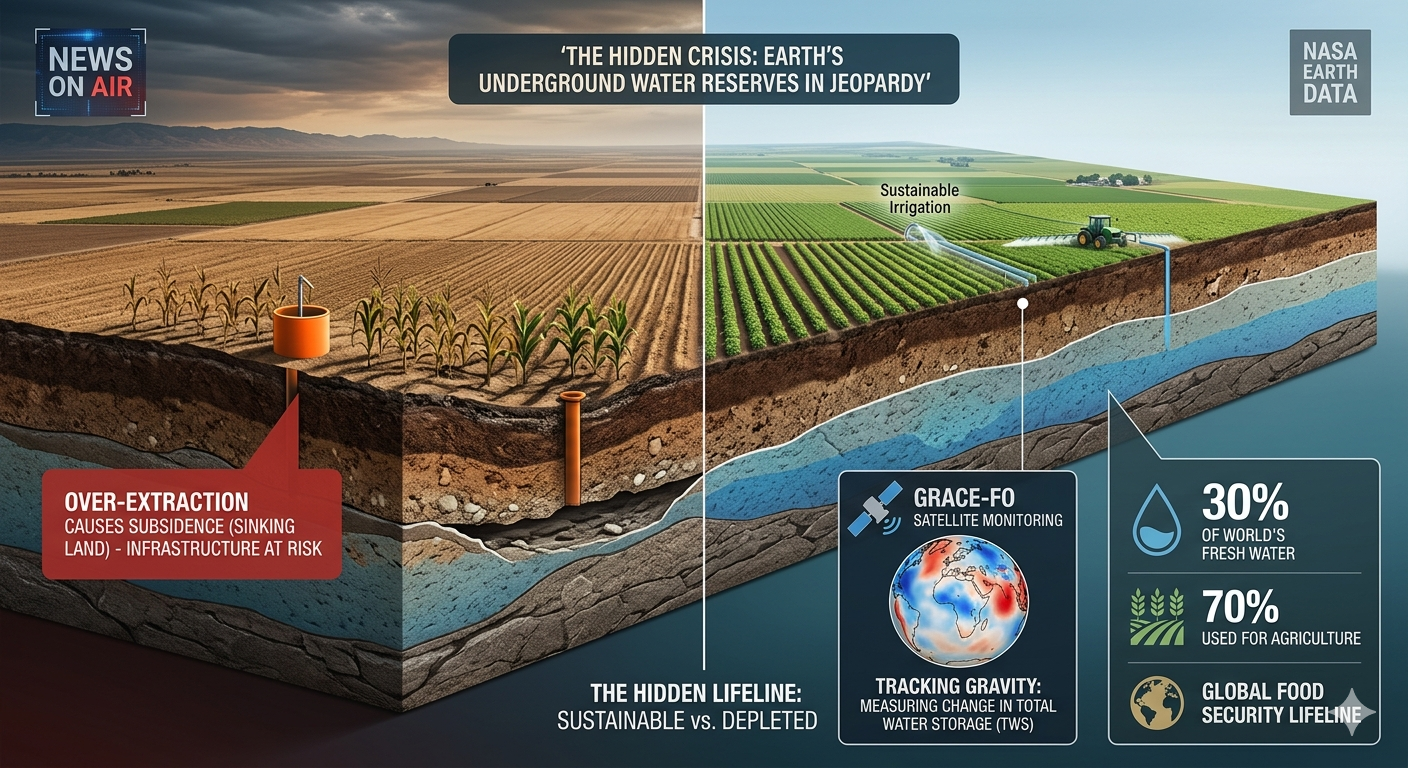
WASHINGTON D.C. — While the world’s attention is often captured by the visible impacts of climate change—such as shrinking glaciers and rising sea levels—a quieter, equally significant crisis is unfolding beneath our feet. Groundwater, which accounts for nearly 30% of the world’s fresh water, is being depleted at rates that threaten global food security and economic stability.
Recent data from NASA highlights that this invisible lifeline, stored in the pores of soil and rock fractures known as aquifers, is the primary source of water for agriculture, industry, and billions of people worldwide.
The Invisible Foundation of Agriculture
Groundwater acts as the world's most reliable buffer against drought, yet it is under unprecedented strain.
-
Agricultural Dependency: Globally, approximately 70% of all groundwater withdrawals are dedicated to crop irrigation.
-
The Food Connection: Major breadbaskets, including the Indo-Gangetic Plain and California’s Central Valley, rely almost entirely on these underground reservoirs to maintain the global food supply.
-
Nature’s Backup: During dry seasons, groundwater maintains the flow of rivers and preserves the health of vital wetland ecosystems.
Seeing Underground with Gravity
Because groundwater is hidden, monitoring its levels requires more than just traditional observation. NASA utilizes the GRACE-FO (Gravity Recovery and Climate Experiment Follow-On) satellite mission to track changes in the Earth’s gravity field.
-
Tracking Mass: As water is pumped out of the ground, the region actually loses mass. These minute changes in mass affect the local gravitational pull, which satellites can detect from orbit.
-
Holistic Monitoring: Scientists track Total Water Storage (TWS), a metric that combines groundwater, soil moisture, surface water, snow, and ice to provide a complete picture of the terrestrial hydrosphere.
-
Early Warnings: This data allows for more accurate drought monitoring, helping governments identify water shortages long before they lead to crop failures.
The Cost of Over-Extraction: Sinking Cities
When we pump water faster than nature can "recharge" it through rain and snowmelt, the consequences become visible on the surface.
-
Land Subsidence: As water is removed, the soil and rock layers can collapse or compress, causing the Earth’s surface to literally sink.
-
Infrastructure Damage: This subsidence leads to permanent damage to roads, bridges, and underground utility pipes, costing billions in repairs.
-
Reduced Capacity: Once an aquifer collapses due to subsidence, it loses its ability to store water in the future, even if heavy rains return.
The Bottom Line: As weather patterns shift and demand grows, protecting the terrestrial hydrosphere is no longer just a scientific endeavor—it is a fundamental requirement for 21st-century survival.
