


Securing Every Drop: Unpacking Singapore's Brilliant 'Four National Taps' Water Strategy
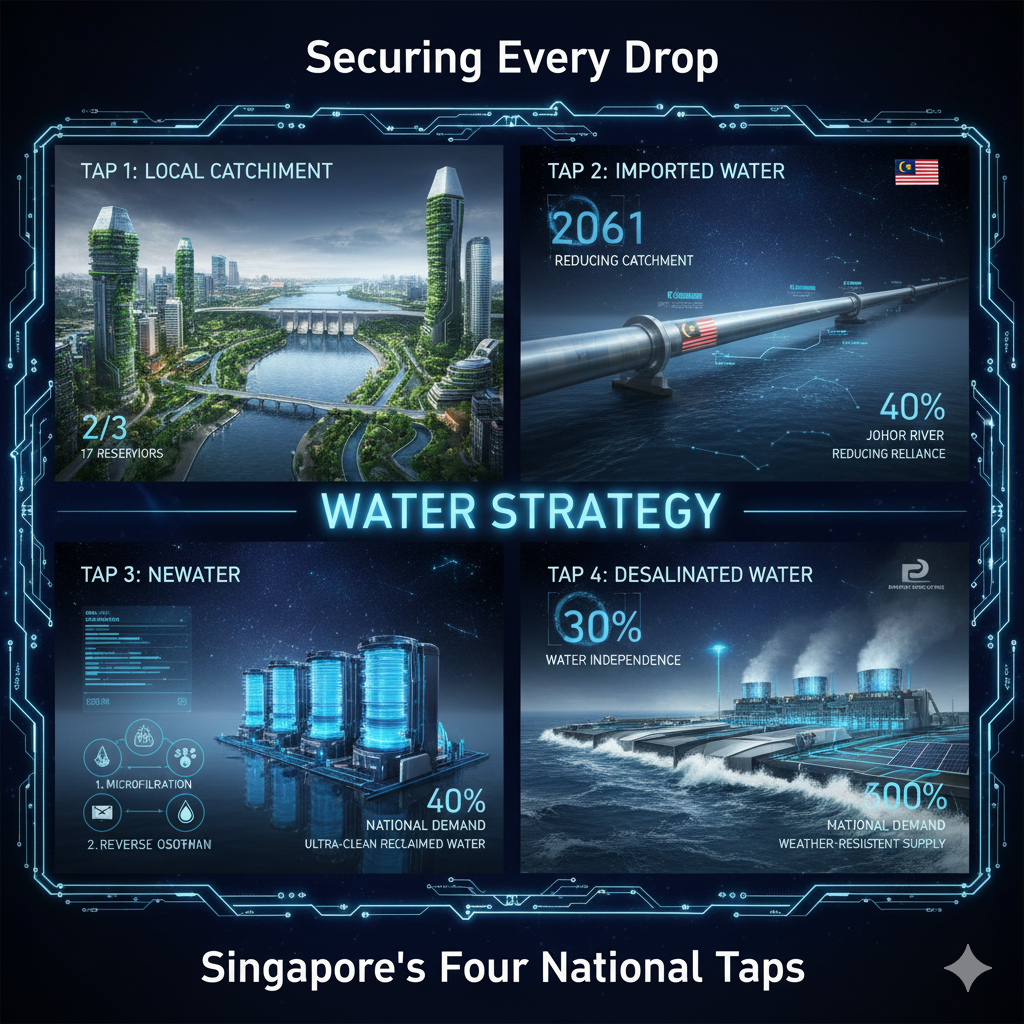
The recent pollution incident that briefly shut down the Johor River Waterworks in Malaysia served as a critical reminder: for the island nation of Singapore, water security is not just a policy—it’s a matter of national survival.
Since its independence, Singapore has transformed itself from one of the most water-stressed countries in the world to a global model of integrated water management. At the heart of this success is a visionary, multi-pronged approach known as the "Four National Taps."
This strategy ensures that even if one source faces a crisis (like a pollution event or drought), the nation’s supply remains robust and uninterrupted, pushing Singapore towards its goal of complete water self-sufficiency by the year 2061, the expiry date of its key water agreement with Malaysia.
🌊 Tap 1: Water from Local Catchment
This is the most traditional source, but executed on a massive, innovative scale.
-
The Principle: Collect every drop of rain that falls on the island.
-
The Execution: Today, two-thirds of Singapore’s land surface is designed to function as a water catchment area. An extensive network of drains and canals channels rainwater into 17 reservoirs.
-
Flagship Project: The Marina Barrage, a dam across the mouth of the Marina Channel, is a marvel of urban planning. It keeps seawater out and creates Singapore's largest and most crucial urban freshwater reservoir, simultaneously helping with flood control.
-
The ABC Programme: The Active, Beautiful, Clean (ABC) Waters Programme integrates reservoirs, rivers, and canals into the urban landscape, creating attractive community spaces while maximizing rainwater harvesting efficiency.
Tap 2: Imported Water (The Historical Tap)
Historically, this has been Singapore’s most vulnerable source, hence the drive for self-sufficiency.
-
The Source: Under the 1962 Water Agreement with Malaysia, Singapore is entitled to draw up to 250 million gallons of raw water per day from the Johor River.
-
The Role: While still a vital source today (and often the cheapest due to historical pricing), Singapore is actively reducing its reliance on this tap through the development of Taps 3 and 4, ensuring national security is not tied to a single external source.
🧪 Tap 3: NEWater (The Technological Marvel)
NEWater is Singapore's brand name for ultra-clean, high-grade reclaimed water, a testament to technological prowess.
-
The Process: Used water is purified through a rigorous three-stage process:
-
Microfiltration: Removes suspended solids and bacteria.
-
Reverse Osmosis (RO): Pushes water through a semi-permeable membrane to filter out viruses, bacteria, and salts.
-
UV Disinfection: Provides a final layer of safety to ensure the water is ultra-pure.
-
-
Current Contribution: NEWater currently meets about 40% of the nation’s water demand and is primarily used by non-domestic sectors, such as wafer fabrication and industrial cooling, to free up drinking water for homes.
-
The Future: By 2060, NEWater is projected to meet up to 55% of Singapore’s total water demand, closing the water loop and demonstrating that every drop can be reused endlessly.
🏭 Tap 4: Desalinated Water (The Drought Buster)
Turning the surrounding seawater into drinking water provides a crucial, weather-resilient supply.
-
The Technology: Seawater is treated, primarily through Reverse Osmosis, to remove salt and minerals.
-
The Goal: Desalination plants currently meet up to 30% of Singapore’s water needs. They are critical during dry spells when local catchment levels are low. Singapore is continuously investing in research to reduce the high energy consumption typically associated with desalination.
-
Resilience: Along with NEWater, this tap provides a stable supply that is independent of rainfall and external political factors.
💡 A Model for the World
The Four National Taps strategy is more than just infrastructure; it represents a commitment to integrated management, innovation, and public education. The seamless switch to NEWater and desalinated supplies during the recent Johor pollution incident proves that this resilience plan is not theoretical—it’s operational.
Singapore has shown the world that even small nations facing existential resource challenges can secure a sustainable future through forward planning, heavy investment in R&D, and strong political resolve.
