


AFB-Xpert Panel (M.Tb Detection & Rifamipicin resistance) by CBNAAT - Extra pulmonary samples
New
2,570.00₹
In stock
Hyderabad
0 Reviews
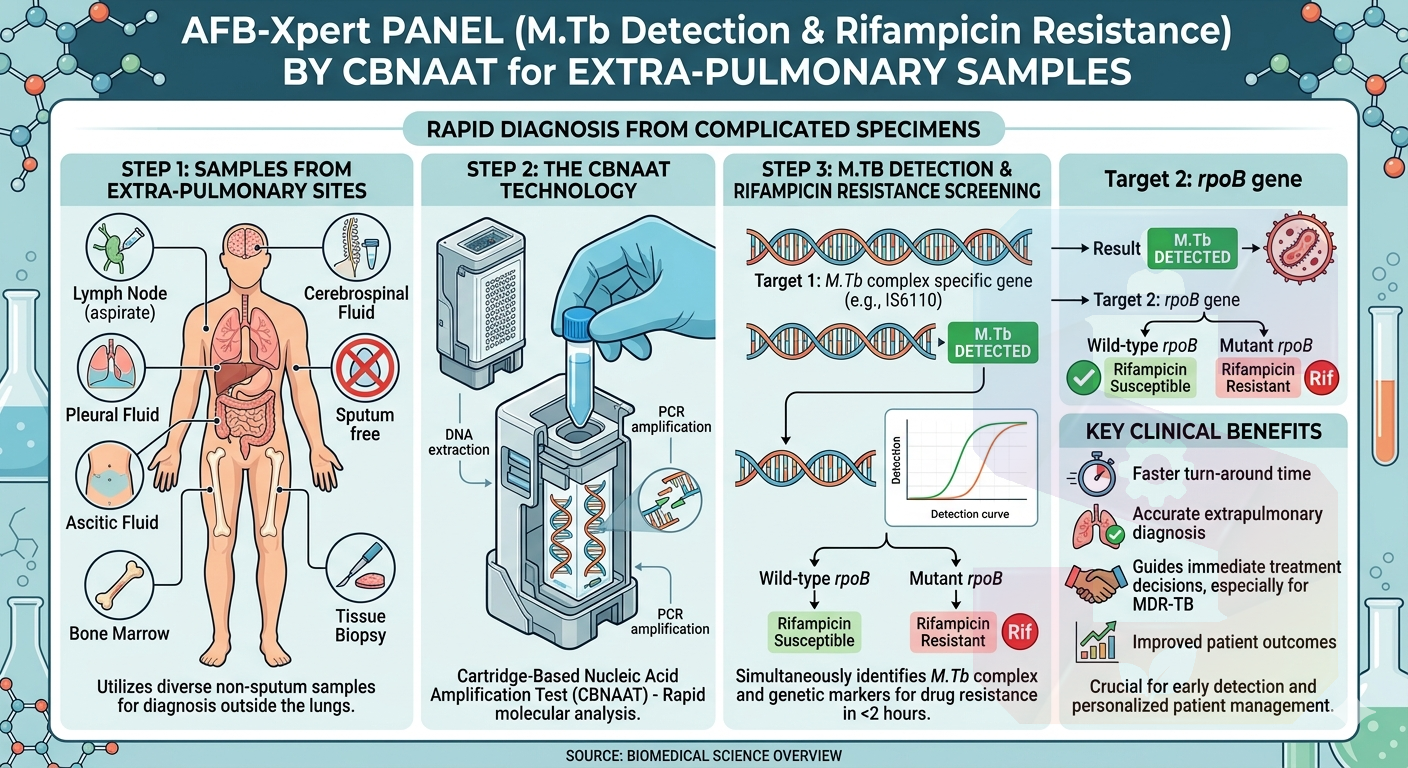
An AFB-Xpert Panel (M.Tb Detection & Rifampicin Resistance) by CBNAAT for extra-pulmonary samples is a rapid molecular test used to detect Mycobacterium tuberculosis (the bacteria that causes TB) and check if it is resistant to Rifampicin, a core first-line TB medication.
When performed on extra-pulmonary samples (tissue or fluid from outside the lungs), it is a crucial tool for diagnosing complex, hard-to-reach TB infections.
1. What does the name mean?
AFB: Acid-Fast Bacilli (the family of bacteria Mycobacterium tuberculosis belongs to).
CBNAAT: Cartridge-Based Nucleic Acid Amplification Test. It is a fully automated PCR (polymerase chain reaction) test that looks for the DNA of the bacteria.
Extra-pulmonary samples: Samples taken from body parts other than the lungs.
2. Common Sample Types Used
Because extra-pulmonary TB can affect almost any organ, the test can be run on various non-sputum samples, including:
Fluids: Pleural fluid (lung lining), cerebrospinal fluid (CSF for TB meningitis), ascitic fluid (abdomen), or synovial fluid (joints).
Tissue: Lymph node aspirates (FNAC) or biopsy tissue from suspected organs.
Urine: Used in suspected urogenital TB.
3. What the Test Detects
The test provides two critical pieces of information simultaneously, usually within 2 hours:
M.Tb Detection (Positive/Negative): Confirms whether Mycobacterium tuberculosis DNA is present in the sample.
Rifampicin (Rif) Resistance (Detected/Not Detected): It targets the rpoB gene of the bacteria. If mutations are found in this gene, it indicates the strain is resistant to Rifampicin. Because Rifampicin resistance is highly correlated with multi-drug resistant TB (MDR-TB), this serves as a critical early warning.
When performed on extra-pulmonary samples (tissue or fluid from outside the lungs), it is a crucial tool for diagnosing complex, hard-to-reach TB infections.
1. What does the name mean?
AFB: Acid-Fast Bacilli (the family of bacteria Mycobacterium tuberculosis belongs to).
CBNAAT: Cartridge-Based Nucleic Acid Amplification Test. It is a fully automated PCR (polymerase chain reaction) test that looks for the DNA of the bacteria.
Extra-pulmonary samples: Samples taken from body parts other than the lungs.
2. Common Sample Types Used
Because extra-pulmonary TB can affect almost any organ, the test can be run on various non-sputum samples, including:
Fluids: Pleural fluid (lung lining), cerebrospinal fluid (CSF for TB meningitis), ascitic fluid (abdomen), or synovial fluid (joints).
Tissue: Lymph node aspirates (FNAC) or biopsy tissue from suspected organs.
Urine: Used in suspected urogenital TB.
3. What the Test Detects
The test provides two critical pieces of information simultaneously, usually within 2 hours:
M.Tb Detection (Positive/Negative): Confirms whether Mycobacterium tuberculosis DNA is present in the sample.
Rifampicin (Rif) Resistance (Detected/Not Detected): It targets the rpoB gene of the bacteria. If mutations are found in this gene, it indicates the strain is resistant to Rifampicin. Because Rifampicin resistance is highly correlated with multi-drug resistant TB (MDR-TB), this serves as a critical early warning.
An AFB-Xpert Panel (M.Tb Detection & Rifampicin Resistance) by CBNAAT for extra-pulmonary samples is a rapid molecular test used to detect Mycobacterium tuberculosis (the bacteria that causes TB) and check if it is resistant to Rifampicin, a core first-line TB medication.
When performed on extra-pulmonary samples (tissue or fluid from outside the lungs), it is a crucial tool for diagnosing complex, hard-to-reach TB infections.
1. What does the name mean?
AFB: Acid-Fast Bacilli (the family of bacteria Mycobacterium tuberculosis belongs to).
CBNAAT: Cartridge-Based Nucleic Acid Amplification Test. It is a fully automated PCR (polymerase chain reaction) test that looks for the DNA of the bacteria.
Extra-pulmonary samples: Samples taken from body parts other than the lungs.
2. Common Sample Types Used
Because extra-pulmonary TB can affect almost any organ, the test can be run on various non-sputum samples, including:
Fluids: Pleural fluid (lung lining), cerebrospinal fluid (CSF for TB meningitis), ascitic fluid (abdomen), or synovial fluid (joints).
Tissue: Lymph node aspirates (FNAC) or biopsy tissue from suspected organs.
Urine: Used in suspected urogenital TB.
3. What the Test Detects
The test provides two critical pieces of information simultaneously, usually within 2 hours:
M.Tb Detection (Positive/Negative): Confirms whether Mycobacterium tuberculosis DNA is present in the sample.
Rifampicin (Rif) Resistance (Detected/Not Detected): It targets the rpoB gene of the bacteria. If mutations are found in this gene, it indicates the strain is resistant to Rifampicin. Because Rifampicin resistance is highly correlated with multi-drug resistant TB (MDR-TB), this serves as a critical early warning.
