


• 25 OH Vitamin D Blood Test New
    1,280.00₹
    In stock
    0 Reviews
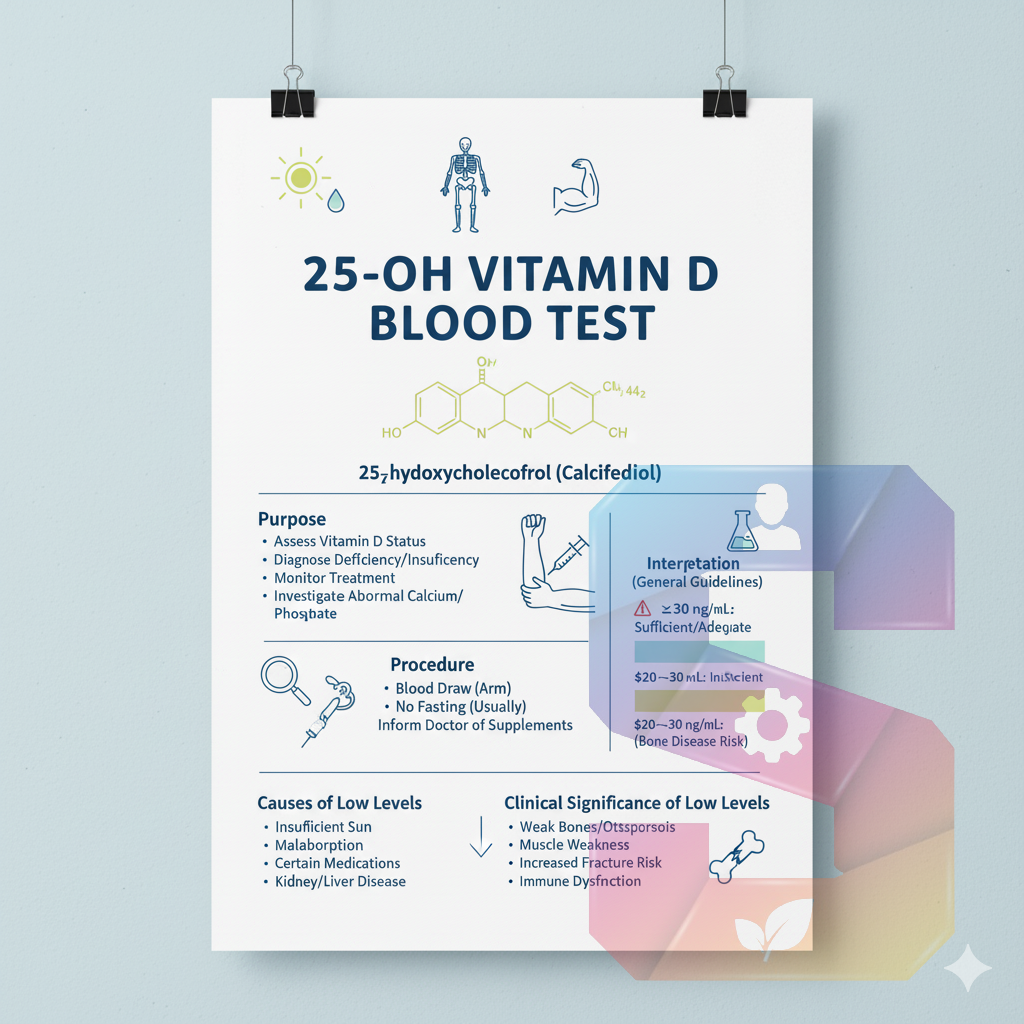
    25 OH Vitamin D blood test, often called the Vitamin D Test, is the most accurate way to measure the body's vitamin D status.
    Purpose Assess Vitamin D Status: Measures the main circulating form of Vitamin D (Calcidiol), reflecting total intake from sun exposure, diet, and supplements.
    Diagnose Deficiency or Insufficiency: Used to determine if levels are too low, which can lead to bone disorders like rickets in children and osteomalacia/osteoporosis in adults.
    Monitor Treatment: Evaluates the effectiveness of vitamin D supplementation in patients with diagnosed deficiency.
    Investigate Abnormal Calcium/Phosphate: Used in the workup for conditions affecting calcium metabolism, bone health, or parathyroid function.
    25 OH Vitamin D blood test, often called the Vitamin D Test, is the most accurate way to measure the body's vitamin D status. Purpose Assess Vitamin D Status: Measures the main circulating form of Vitamin D (Calcidiol), reflecting total intake from sun exposure, diet, and supplements. Diagnose Deficiency or Insufficiency: Used to determine if levels are too low, which can lead to bone disorders like rickets in children and osteomalacia/osteoporosis in adults. Monitor Treatment: Evaluates the effectiveness of vitamin D supplementation in patients with diagnosed deficiency. Investigate Abnormal Calcium/Phosphate: Used in the workup for conditions affecting calcium metabolism, bone health, or parathyroid function.
    0 Comments 0 Shares 837 Views 0 Reviews
  • 7q Deletion/Monosomy (MDS), Heparin Bone Marrow New
    5,195.00₹
    In stock
    0 Reviews
    This refers to the loss of part or all of chromosome 7's long arm (q-arm), or the entire chromosome, which is a significant cytogenetic abnormality in Myelodysplastic Syndromes (MDS) and often associated with a poorer prognosis.
    Genetic Abnormality:
    Monosomy 7 (-7): Complete loss of one copy of chromosome 7. This is the most common and generally carries the worst prognosis among 7q abnormalities.
    Deletion of 7q : Partial loss of the long arm of chromosome 7. The commonly deleted region (CDR) is typically located at 7q22-7q32.
    Association with Other Conditions: Can occur as a sole abnormality in de novo MDS.
    Frequently seen in therapy-related MDS (t-MDS) and therapy-related Acute Myeloid Leukemia (t-AML), particularly after exposure to alkylating agents or topoisomerase II inhibitors.
    Also associated with MDS in children, especially those with inherited bone marrow failure syndromes (e.g., Fanconi anemia, GATA2 deficiency).

    Clinical Features: Often associated with bicytopenia or pancytopenia (low counts of two or more cell lines), including severe anemia, neutropenia, and thrombocytopenia.
    Increased risk of infections due to neutropenia.
    Higher risk of progression to Acute Myeloid Leukemia (AML) compared to other MDS subtypes, especially with monosomy 7.
    This refers to the loss of part or all of chromosome 7's long arm (q-arm), or the entire chromosome, which is a significant cytogenetic abnormality in Myelodysplastic Syndromes (MDS) and often associated with a poorer prognosis. Genetic Abnormality: Monosomy 7 (-7): Complete loss of one copy of chromosome 7. This is the most common and generally carries the worst prognosis among 7q abnormalities. Deletion of 7q : Partial loss of the long arm of chromosome 7. The commonly deleted region (CDR) is typically located at 7q22-7q32. Association with Other Conditions: Can occur as a sole abnormality in de novo MDS. Frequently seen in therapy-related MDS (t-MDS) and therapy-related Acute Myeloid Leukemia (t-AML), particularly after exposure to alkylating agents or topoisomerase II inhibitors. Also associated with MDS in children, especially those with inherited bone marrow failure syndromes (e.g., Fanconi anemia, GATA2 deficiency). Clinical Features: Often associated with bicytopenia or pancytopenia (low counts of two or more cell lines), including severe anemia, neutropenia, and thrombocytopenia. Increased risk of infections due to neutropenia. Higher risk of progression to Acute Myeloid Leukemia (AML) compared to other MDS subtypes, especially with monosomy 7.
    0 Comments 0 Shares 909 Views 0 Reviews