


• Anti Hepatitis B Core Antibody (AHBC) Total New
    1,045.00₹
    In stock
    All over India
    0 Reviews
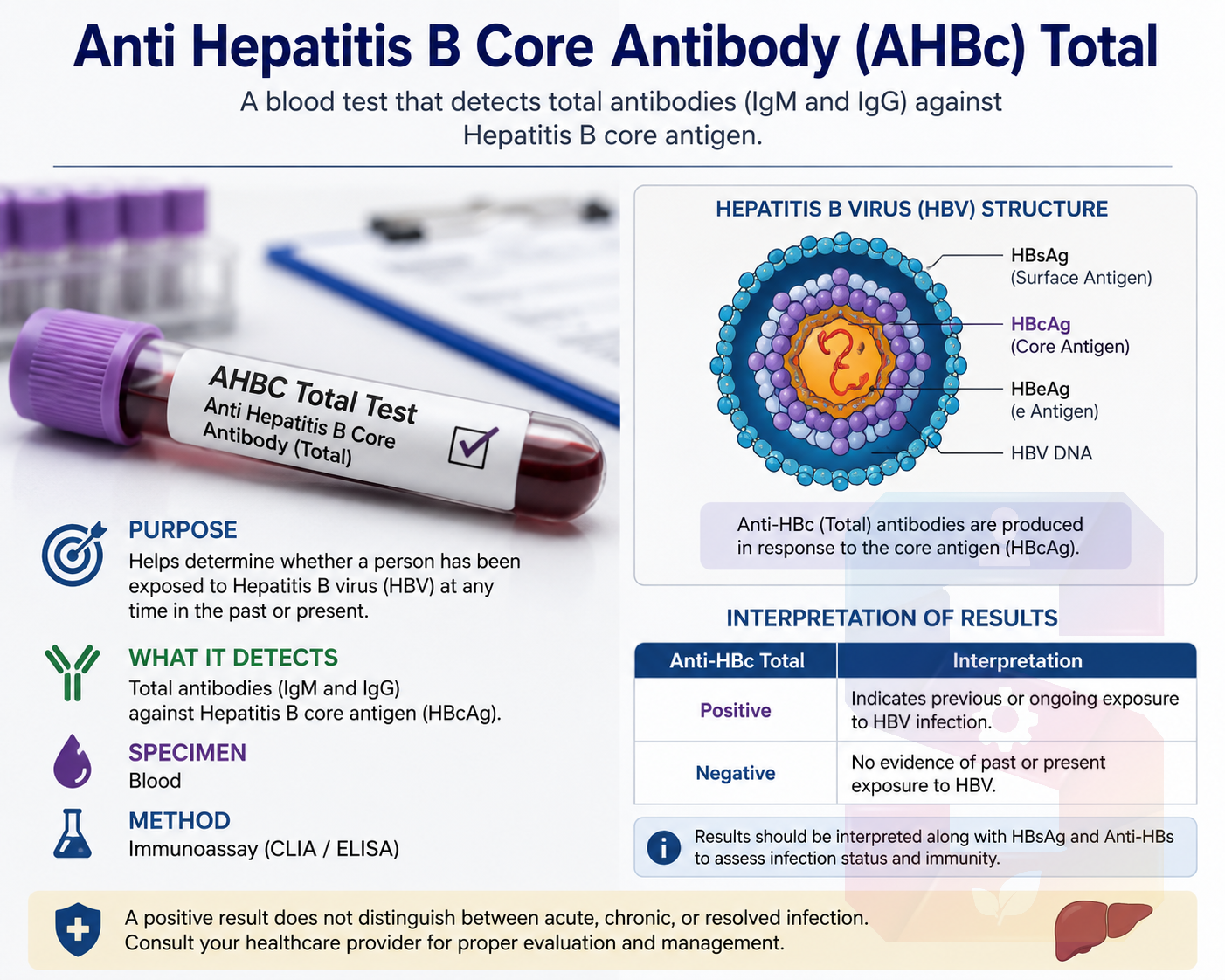
    Anti-Hepatitis B Core Antibody (AHBc) Total is a blood test that detects total antibodies (IgM and IgG) against the hepatitis B core antigen. It helps determine whether a person has been exposed to the hepatitis B virus (HBV) at any time in the past or present. A positive result indicates previous or ongoing HBV infection but does not distinguish between acute, chronic, or resolved infection. This test is commonly interpreted along with HBsAg and Anti-HBs to assess infection status and immunity. It is an important tool for diagnosing hepatitis B and guiding appropriate medical evaluation and management.
    Anti-Hepatitis B Core Antibody (AHBc) Total is a blood test that detects total antibodies (IgM and IgG) against the hepatitis B core antigen. It helps determine whether a person has been exposed to the hepatitis B virus (HBV) at any time in the past or present. A positive result indicates previous or ongoing HBV infection but does not distinguish between acute, chronic, or resolved infection. This test is commonly interpreted along with HBsAg and Anti-HBs to assess infection status and immunity. It is an important tool for diagnosing hepatitis B and guiding appropriate medical evaluation and management.
    0 Comments 0 Shares 625 Views 0 Reviews
  • Anti cardiolipin antibody (IGG+IGM) diagnostic test New
    1,540.00₹
    In stock
    Hyderabad
    0 Reviews
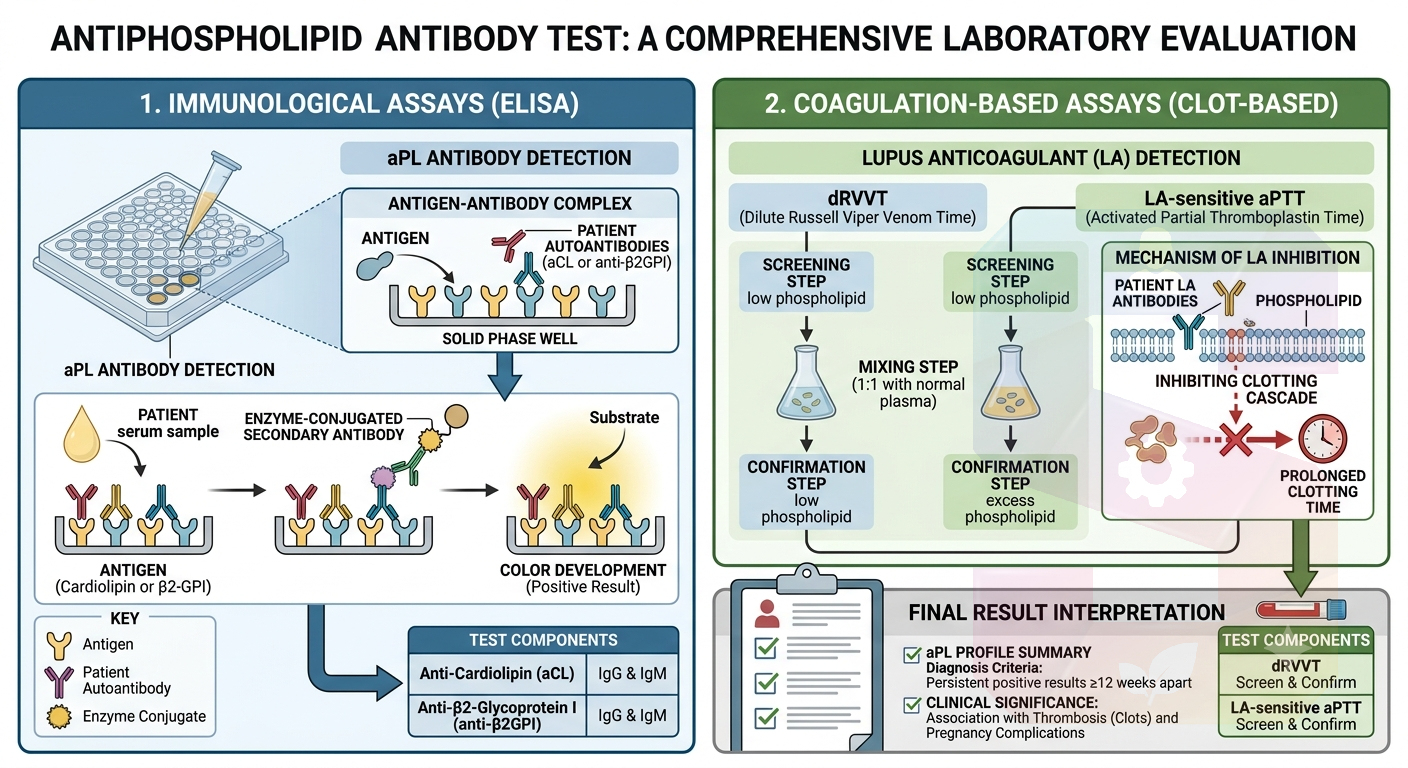
    **Anti-cardiolipin (aCL) IgG and IgM antibodies** are autoantibodies—immune proteins that mistakenly target the body's own cell membranes, specifically phospholipids.
    Testing for both types is essential when evaluating unexplained blood clots, recurrent miscarriages, or autoimmune diseases like systemic lupus erythematosus (SLE). **IgM** antibodies usually appear first during an initial immune response, while **IgG** antibodies develop later and typically persist longer, often carrying a stronger clinical association with clotting risks.
    Elevated levels of either antibody serve as primary diagnostic markers for **Antiphospholipid Syndrome (APS)**, a condition requiring careful medical management to prevent future thrombotic events.
    **Anti-cardiolipin (aCL) IgG and IgM antibodies** are autoantibodies—immune proteins that mistakenly target the body's own cell membranes, specifically phospholipids. Testing for both types is essential when evaluating unexplained blood clots, recurrent miscarriages, or autoimmune diseases like systemic lupus erythematosus (SLE). **IgM** antibodies usually appear first during an initial immune response, while **IgG** antibodies develop later and typically persist longer, often carrying a stronger clinical association with clotting risks. Elevated levels of either antibody serve as primary diagnostic markers for **Antiphospholipid Syndrome (APS)**, a condition requiring careful medical management to prevent future thrombotic events.
    0 Comments 0 Shares 363 Views 0 Reviews
  • Ante Natal Panel 1 Diagnostic Test New
    935.00₹
    In stock
    Hyderabad
    0 Reviews
    Here is a concise, 100-word product description for an e-commerce or medical listing:

    The **Ante Natal Panel 1 Diagnostic Test** is a comprehensive screening profile designed to assess maternal health and ensure optimal fetal development during early pregnancy. This essential panel includes a complete blood count (CBC), blood grouping, Rh typing, and screenings for critical infectious diseases such as HIV, Hepatitis B (HBsAg), and Syphilis (VDRL). By detecting potential risk factors early, this routine test allows healthcare providers to implement timely interventions, preventing complications and supporting a safe, healthy pregnancy journey. Fast, accurate, and reliable, it is the foundational step in proactive prenatal care.
    Here is a concise, 100-word product description for an e-commerce or medical listing: The **Ante Natal Panel 1 Diagnostic Test** is a comprehensive screening profile designed to assess maternal health and ensure optimal fetal development during early pregnancy. This essential panel includes a complete blood count (CBC), blood grouping, Rh typing, and screenings for critical infectious diseases such as HIV, Hepatitis B (HBsAg), and Syphilis (VDRL). By detecting potential risk factors early, this routine test allows healthcare providers to implement timely interventions, preventing complications and supporting a safe, healthy pregnancy journey. Fast, accurate, and reliable, it is the foundational step in proactive prenatal care.
    0 Comments 0 Shares 463 Views 0 Reviews
  • Ankle tissue- Large biopsy 1 - 3 cm New
    1,000.00₹
    In stock
    Hyderabad
    0 Reviews
    Here is a concise, professional product description tailored for medical and e-commerce listings:

    This premium **Ankle Tissue (Large Biopsy, 1–3 cm)** specimen is ethically sourced and meticulously processed to meet rigorous biomedical research and diagnostic standards. Sourced from the crucial ankle region, this larger tissue volume provides comprehensive cell populations and structural integrity, making it ideal for studying joint disorders, ligament repair, osteoarthritis, and histopathological anomalies. Each biopsy undergoes immediate, controlled preservation to maintain optimal cellular morphology and biomolecular composition. Count on this reliable, fully documented specimen to deliver consistent, high-fidelity results for your critical orthopedic studies and diagnostic assay validations.
    Here is a concise, professional product description tailored for medical and e-commerce listings: This premium **Ankle Tissue (Large Biopsy, 1–3 cm)** specimen is ethically sourced and meticulously processed to meet rigorous biomedical research and diagnostic standards. Sourced from the crucial ankle region, this larger tissue volume provides comprehensive cell populations and structural integrity, making it ideal for studying joint disorders, ligament repair, osteoarthritis, and histopathological anomalies. Each biopsy undergoes immediate, controlled preservation to maintain optimal cellular morphology and biomolecular composition. Count on this reliable, fully documented specimen to deliver consistent, high-fidelity results for your critical orthopedic studies and diagnostic assay validations.
    0 Comments 0 Shares 402 Views 0 Reviews
  • ANA Screening by IFA Diagnostic Test New
    1,100.00₹
    In stock
    Hyderabad
    0 Reviews
    An **ANA Screening by IFA Diagnostic Test** (Antinuclear Antibody Screening by Immunofluorescence Assay) is the gold-standard blood test used to detect autoantibodies that mistakenly target a patient's own cellular nuclei. Utilizing a fluorescent microscope, laboratory technicians examine human epithelial cells (HeP-2) mixed with the patient's blood serum to look for specific glowing patterns.

    This critical diagnostic screening is the foundational first step in identifying systemic autoimmune conditions, such as Systemic Lupus Erythematosus (SLE), Sjögren's syndrome, and rheumatoid arthritis. A positive result provides crucial initial data, prompting further specific autoantibody testing to establish an accurate medical diagnosis.
    An **ANA Screening by IFA Diagnostic Test** (Antinuclear Antibody Screening by Immunofluorescence Assay) is the gold-standard blood test used to detect autoantibodies that mistakenly target a patient's own cellular nuclei. Utilizing a fluorescent microscope, laboratory technicians examine human epithelial cells (HeP-2) mixed with the patient's blood serum to look for specific glowing patterns. This critical diagnostic screening is the foundational first step in identifying systemic autoimmune conditions, such as Systemic Lupus Erythematosus (SLE), Sjögren's syndrome, and rheumatoid arthritis. A positive result provides crucial initial data, prompting further specific autoantibody testing to establish an accurate medical diagnosis.
    0 Comments 0 Shares 360 Views 0 Reviews
  • Amylase Enzymatic Ascitic Fluid Diagnostic Test New
    650.00₹
    In stock
    Hyderabad
    0 Reviews
    An **Amylase Enzymatic Ascitic Fluid Diagnostic Test** analyzes the fluid accumulated within the abdominal cavity—known as ascitic fluid—to measure the concentration of the digestive enzyme amylase. This specialized evaluation is crucial when clinicians suspect that a patient’s ascites is driven by pancreatic pathology rather than liver disease.

    Markedly elevated amylase levels in the fluid typically signify a pancreatic duct disruption, severe acute pancreatitis, or a pancreatic pseudocyst leaking into the peritoneum. By differentiating pancreatic ascites from other causes, this diagnostic test provides vital clarity, enabling medical teams to deliver highly targeted, urgent therapeutic interventions.
    An **Amylase Enzymatic Ascitic Fluid Diagnostic Test** analyzes the fluid accumulated within the abdominal cavity—known as ascitic fluid—to measure the concentration of the digestive enzyme amylase. This specialized evaluation is crucial when clinicians suspect that a patient’s ascites is driven by pancreatic pathology rather than liver disease. Markedly elevated amylase levels in the fluid typically signify a pancreatic duct disruption, severe acute pancreatitis, or a pancreatic pseudocyst leaking into the peritoneum. By differentiating pancreatic ascites from other causes, this diagnostic test provides vital clarity, enabling medical teams to deliver highly targeted, urgent therapeutic interventions.
    0 Comments 0 Shares 205 Views 0 Reviews
  • Amputation (Limb) Biopsy Diagnostic Test New
    1,500.00₹
    In stock
    Hyderabad
    0 Reviews
    An **Amputation (Limb) Biopsy** is a critical diagnostic procedure performed to analyze tissue from a severely diseased, non-viable, or previously amputated limb. Unlike standard small-needle biopsies, this intervention involves sampling bone, muscle, or vascular structures from a major limb segment.

    Pathologists utilize this diagnostic test to investigate aggressive underlying conditions, such as primary bone malignancies (like osteosarcoma), deep soft-tissue sarcomas, or severe, necrotizing infections. By providing definitive histological confirmation of a disease's type and margin involvement, the biopsy plays a crucial role in establishing accurate post-surgical diagnoses and tailoring subsequent oncological or medical treatments.
    An **Amputation (Limb) Biopsy** is a critical diagnostic procedure performed to analyze tissue from a severely diseased, non-viable, or previously amputated limb. Unlike standard small-needle biopsies, this intervention involves sampling bone, muscle, or vascular structures from a major limb segment. Pathologists utilize this diagnostic test to investigate aggressive underlying conditions, such as primary bone malignancies (like osteosarcoma), deep soft-tissue sarcomas, or severe, necrotizing infections. By providing definitive histological confirmation of a disease's type and margin involvement, the biopsy plays a crucial role in establishing accurate post-surgical diagnoses and tailoring subsequent oncological or medical treatments.
    0 Comments 0 Shares 220 Views 0 Reviews
  • Allergy Screening Tryptase Diagnostic Test New
    2,000.00₹
    In stock
    Hyderabad
    0 Reviews
    The Allergy Screening Tryptase Diagnostic Test is a crucial blood test used to measure the levels of tryptase, an enzyme primarily released by mast cells during severe allergic reactions. It serves as a vital biomarker to confirm cases of systemic anaphylaxis, helping clinicians differentiate life-threatening allergic responses from other medical emergencies.

    Beyond acute episodes, this test is instrumental in diagnosing mast cell activation syndrome (MCAS) and mastocytosis—a rare disorder characterized by an abnormal accumulation of mast cells. Measuring both baseline and peak tryptase levels provides healthcare professionals with essential data to assess allergic severity and guide long-term management strategies.
    The Allergy Screening Tryptase Diagnostic Test is a crucial blood test used to measure the levels of tryptase, an enzyme primarily released by mast cells during severe allergic reactions. It serves as a vital biomarker to confirm cases of systemic anaphylaxis, helping clinicians differentiate life-threatening allergic responses from other medical emergencies. Beyond acute episodes, this test is instrumental in diagnosing mast cell activation syndrome (MCAS) and mastocytosis—a rare disorder characterized by an abnormal accumulation of mast cells. Measuring both baseline and peak tryptase levels provides healthcare professionals with essential data to assess allergic severity and guide long-term management strategies.
    0 Comments 0 Shares 511 Views 0 Reviews
  • Alcohol Ethanol Serum Diagnostic test New
    1,150.00₹
    In stock
    Hyderabad
    0 Reviews
    An Alcohol (Ethanol) Serum Diagnostic Test is a clinical blood test used to accurately measure the precise concentration of ethanol—the active alcohol found in beverages—in a person's bloodstream.

    Unlike breathalyzers, which estimate alcohol levels from breath, this laboratory test utilizes blood serum to provide highly accurate, definitive quantitative measurements.

    Clinicians rely on this test in emergency medical settings to evaluate suspected alcohol poisoning, investigate altered mental states, and ensure patient safety during trauma care. It is also widely utilized for legal, occupational, and forensic drug monitoring programs to confirm recent alcohol ingestion.
    An Alcohol (Ethanol) Serum Diagnostic Test is a clinical blood test used to accurately measure the precise concentration of ethanol—the active alcohol found in beverages—in a person's bloodstream. Unlike breathalyzers, which estimate alcohol levels from breath, this laboratory test utilizes blood serum to provide highly accurate, definitive quantitative measurements. Clinicians rely on this test in emergency medical settings to evaluate suspected alcohol poisoning, investigate altered mental states, and ensure patient safety during trauma care. It is also widely utilized for legal, occupational, and forensic drug monitoring programs to confirm recent alcohol ingestion.
    0 Comments 0 Shares 472 Views 0 Reviews
  • Albert Stain smear diagnostic test New
    450.00₹
    In stock
    Hyderabad
    0 Reviews
    Albert stain smear is a rapid differential staining technique primarily used to detect and identify Corynebacterium diphtheriae, the bacterium responsible for diphtheria.

    The process highlights characteristic metachromatic granules (Babes-Ernst bodies) within the bacteria. When stained, the bacterial body appears light green, while the specialized storage granules stain an intense blue-black, creating a distinct "dashed" or "beaded" look under a microscope.

    This simple smear test is a crucial diagnostic tool. It allows healthcare providers to quickly differentiate dangerous diphtheria-causing organisms from harmless throat bacteria, ensuring rapid medical intervention and timely treatment.
    Albert stain smear is a rapid differential staining technique primarily used to detect and identify Corynebacterium diphtheriae, the bacterium responsible for diphtheria. The process highlights characteristic metachromatic granules (Babes-Ernst bodies) within the bacteria. When stained, the bacterial body appears light green, while the specialized storage granules stain an intense blue-black, creating a distinct "dashed" or "beaded" look under a microscope. This simple smear test is a crucial diagnostic tool. It allows healthcare providers to quickly differentiate dangerous diphtheria-causing organisms from harmless throat bacteria, ensuring rapid medical intervention and timely treatment.
    0 Comments 0 Shares 505 Views 0 Reviews
  • AFB-M.Tb detection (M.Tb/NTM Detection) by CBNAAT Ascitic Fluid New
    2,700.00₹
    In stock
    Hyderabad
    0 Reviews
    An AFB-M.Tb Detection (M.Tb/NTM Detection) by CBNAAT on Ascitic Fluid is a targeted molecular diagnostic test designed to identify tuberculosis infections within the peritoneal (abdominal) cavity.

    This specific test is a frontline tool for diagnosing Tuberculous Peritonitis (abdominal TB). What makes this panel unique is its dual capability: it not only checks for the classic Mycobacterium tuberculosis complex but also differentiates it from NTM (Non-Tuberculous Mycobacteria), which require completely different clinical treatment strategies.

    1. Breaking Down the Terminology
    M.Tb: Mycobacterium tuberculosis, the primary pathogen responsible for classic tuberculosis.

    NTM: Non-Tuberculous Mycobacteria (also known as atypical mycobacteria). These are environmental organisms that can mimic TB symptoms and presentation but do not respond to standard anti-TB medications.

    CBNAAT: Cartridge-Based Nucleic Acid Amplification Test. It uses automated, rapid Polymerase Chain Reaction (PCR) technology to detect the specific DNA signatures of these organisms.

    Ascitic Fluid: The fluid that builds up in the peritoneal cavity of the abdomen (a condition called ascites) due to inflammation, infection, or other medical conditions.
    An AFB-M.Tb Detection (M.Tb/NTM Detection) by CBNAAT on Ascitic Fluid is a targeted molecular diagnostic test designed to identify tuberculosis infections within the peritoneal (abdominal) cavity. This specific test is a frontline tool for diagnosing Tuberculous Peritonitis (abdominal TB). What makes this panel unique is its dual capability: it not only checks for the classic Mycobacterium tuberculosis complex but also differentiates it from NTM (Non-Tuberculous Mycobacteria), which require completely different clinical treatment strategies. 1. Breaking Down the Terminology M.Tb: Mycobacterium tuberculosis, the primary pathogen responsible for classic tuberculosis. NTM: Non-Tuberculous Mycobacteria (also known as atypical mycobacteria). These are environmental organisms that can mimic TB symptoms and presentation but do not respond to standard anti-TB medications. CBNAAT: Cartridge-Based Nucleic Acid Amplification Test. It uses automated, rapid Polymerase Chain Reaction (PCR) technology to detect the specific DNA signatures of these organisms. Ascitic Fluid: The fluid that builds up in the peritoneal cavity of the abdomen (a condition called ascites) due to inflammation, infection, or other medical conditions.
    0 Comments 0 Shares 649 Views 0 Reviews
  • AFB -DNA (TB-PCR) detection by RTPCR, reflex to Rifampicin resistance by Ultra CBNAAT (Specimen) diagnostic test New
    2,260.00₹
    In stock
    Hyderabad
    0 Reviews
    Unlike a basic microscopic visual smear, this test directly targets and amplifies the genetic code (DNA) of the Mycobacterium tuberculosis (MTB) bacteria. It is widely considered a frontline diagnostic powerhouse because it answers two vital clinical questions rapidly: Is TB DNA present? and if so, Is it a drug-resistant strain?

    Deconstructing the Complex Test NameAFB-DNA (TB-PCR) by RTPCR:

    This is the first line of the test. The laboratory uses Real-Time Polymerase Chain Reaction (RTPCR) to locate even tiny, fragmented copies of tuberculosis DNA in a sample. It is far more sensitive than a microscope smear and can detect bacteria even in very low concentrations (paucibacillary infections). Reflex to Ultra CBNAAT: "Reflex" means the laboratory computer automatically triggers a secondary, deeper test only if the first step comes back positive. Ultra CBNAAT (Cartridge Based Nucleic Acid Amplification Test): This refers specifically to the GeneXpert MTB/RIF Ultra technology. It is a highly advanced molecular cartridge system that acts as a confirmation step and maps the bacterial genome to look for drug mutations. Rifampicin Resistance: Rifampicin is one of the foundational, most powerful first-line antibiotics used to cure TB. Resistance to Rifampicin is a primary medical warning indicator for MDR-TB (Multidrug-Resistant Tuberculosis), meaning standard TB medications will not work and a specialized treatment path is required.
    Unlike a basic microscopic visual smear, this test directly targets and amplifies the genetic code (DNA) of the Mycobacterium tuberculosis (MTB) bacteria. It is widely considered a frontline diagnostic powerhouse because it answers two vital clinical questions rapidly: Is TB DNA present? and if so, Is it a drug-resistant strain? Deconstructing the Complex Test NameAFB-DNA (TB-PCR) by RTPCR: This is the first line of the test. The laboratory uses Real-Time Polymerase Chain Reaction (RTPCR) to locate even tiny, fragmented copies of tuberculosis DNA in a sample. It is far more sensitive than a microscope smear and can detect bacteria even in very low concentrations (paucibacillary infections). Reflex to Ultra CBNAAT: "Reflex" means the laboratory computer automatically triggers a secondary, deeper test only if the first step comes back positive. Ultra CBNAAT (Cartridge Based Nucleic Acid Amplification Test): This refers specifically to the GeneXpert MTB/RIF Ultra technology. It is a highly advanced molecular cartridge system that acts as a confirmation step and maps the bacterial genome to look for drug mutations. Rifampicin Resistance: Rifampicin is one of the foundational, most powerful first-line antibiotics used to cure TB. Resistance to Rifampicin is a primary medical warning indicator for MDR-TB (Multidrug-Resistant Tuberculosis), meaning standard TB medications will not work and a specialized treatment path is required.
    0 Comments 0 Shares 505 Views 0 Reviews
More Results
Sponsored