


The Hidden Cost of the Green Transition: Critical Minerals and Water Injustice
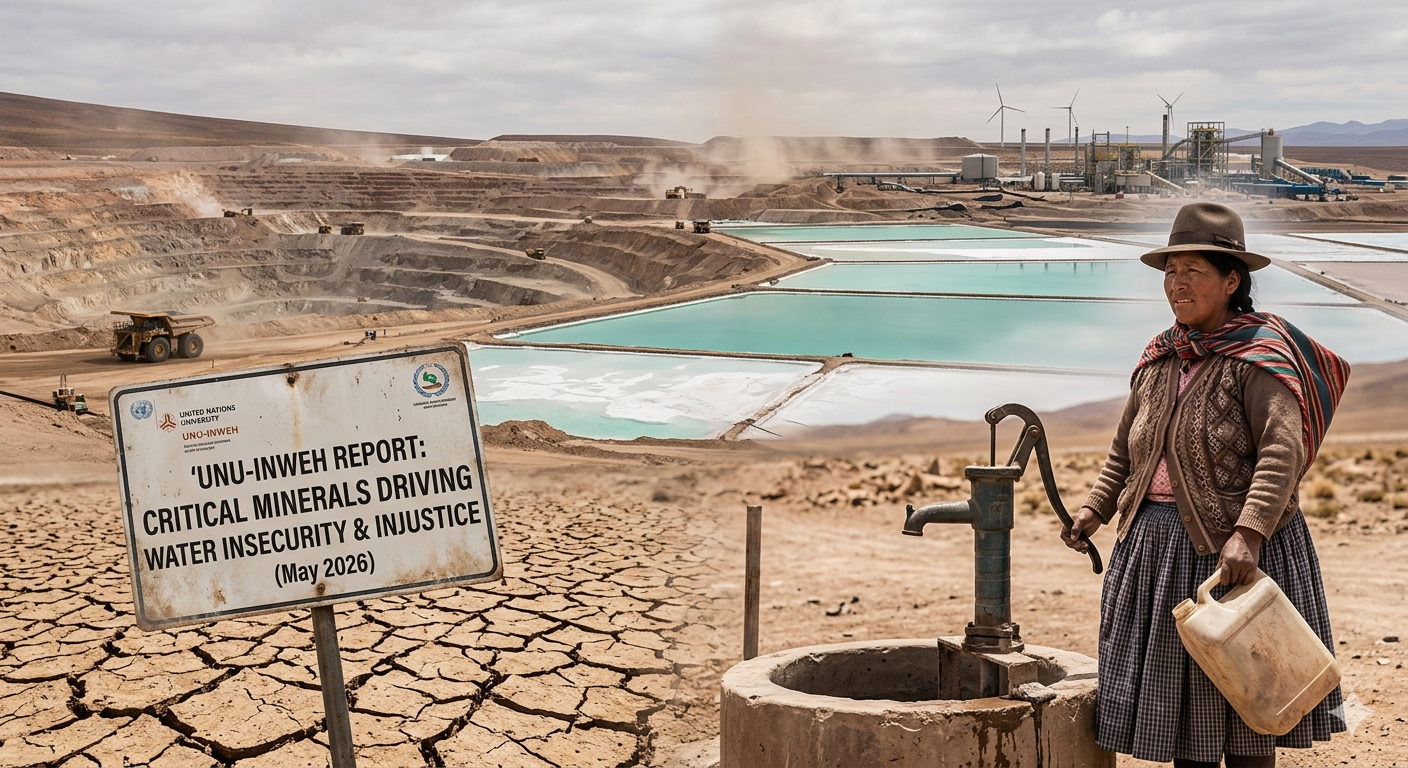
Hamilton, Canada | May 1, 2026 — A landmark report by the UNU Institute for Water, Environment and Health (UNU-INWEH) has exposed a growing paradox in the global fight against climate change. While the world races to secure "critical minerals" like lithium, copper, and cobalt for renewable energy technologies, the mining of these materials is driving a global crisis of water insecurity and social injustice.
The report warns that the quest for a low-carbon future may be coming at the expense of the world's most vulnerable ecosystems and communities.
The Mineral-Water Conflict
The extraction and processing of critical minerals are among the most water-intensive industrial activities on the planet.
-
Massive Consumption: Lithium extraction, particularly from brine in regions like the "Lithium Triangle" in South America, consumes billions of liters of water, often in areas already facing extreme water scarcity.
-
Contamination Risks: Mining operations frequently lead to the contamination of local groundwater and surface water with heavy metals and toxic chemicals used in processing.
-
Resource Competition: In many mining hubs, industrial water demand directly competes with the needs of local agriculture and the domestic water supply for indigenous populations.
Social Injustice and Global Disparities
The report highlights that the burden of this "green extraction" is not shared equally.
-
Geographic Concentration: Much of the world's critical mineral wealth is located in the Global South, where water governance and environmental regulations may be less stringent or poorly enforced.
-
Indigenous Rights: Mining projects are often fast-tracked on ancestral lands without the free, prior, and informed consent of indigenous communities, leading to displacement and loss of traditional livelihoods.
-
Health Hazards: Local populations near mining sites face increased risks of waterborne diseases and long-term health complications due to exposure to contaminated water sources.
A Call for Responsible Governance
UNU-INWEH researchers emphasize that a truly "just transition" requires more than just moving away from fossil fuels; it requires a radical rethinking of how we source raw materials.
-
Circular Economy: Prioritizing mineral recycling and urban mining to reduce the pressure on primary extraction sites.
-
Stricter Standards: Implementing mandatory, transparent water auditing for all mining operations and holding multinational corporations accountable for environmental damage.
-
Community Integration: Ensuring that local and indigenous communities are primary stakeholders in mining decisions, with a guaranteed right to clean, accessible water.
As the demand for electric vehicles and battery storage continues to skyrocket in 2026, the UNU report serves as a critical reminder: we cannot solve the climate crisis by creating a water crisis.
