


📜 Unveiling the Ancient Echoes: Proto-Indo-European Mythology
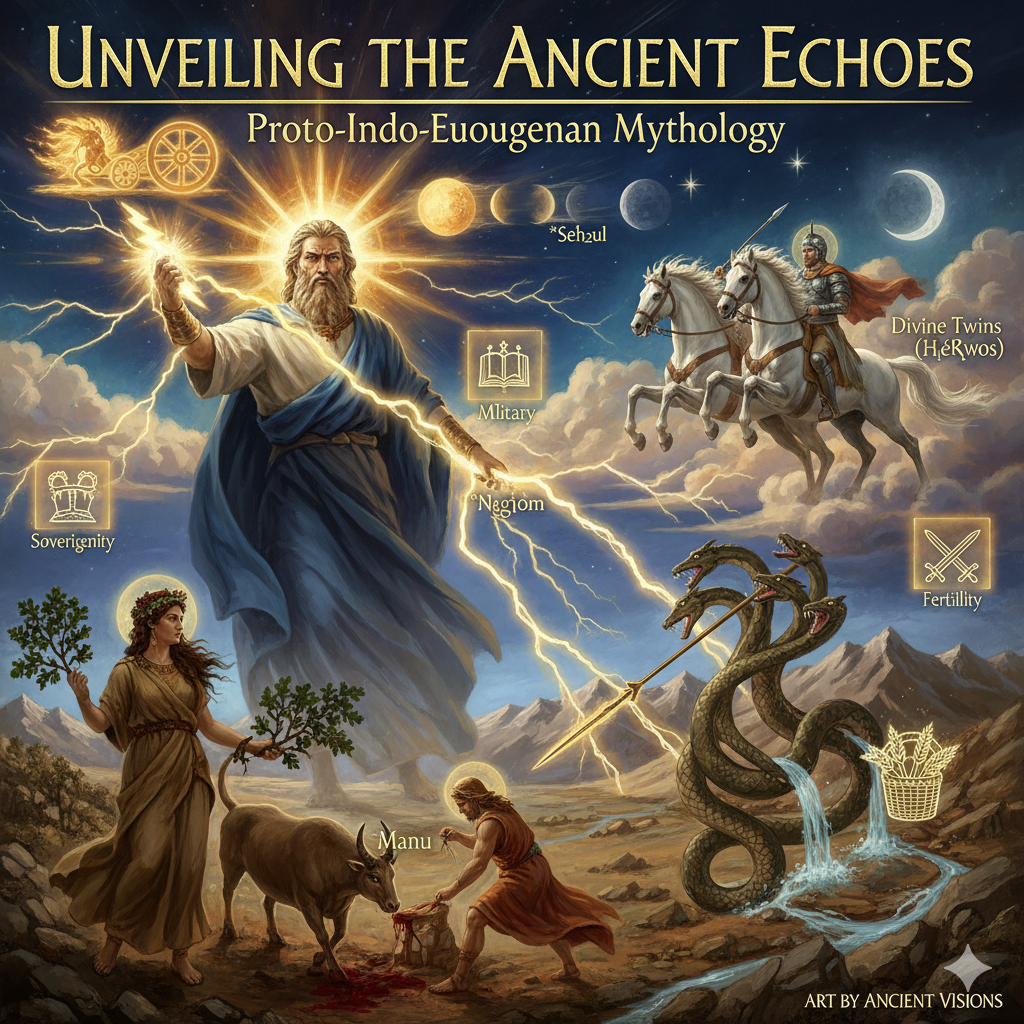
The Proto-Indo-Europeans (PIE) were the hypothetical speakers of the reconstructed Proto-Indo-European language, a culture that existed in preliterate societies. Since they left no written records, their mythology is a remarkable scholarly reconstruction, built by comparing the shared linguistic and thematic elements found across the mythologies of their descendants—from Vedic India and ancient Rome to Norse and Celtic traditions.
This body of reconstructed myth offers a fascinating glimpse into the shared spiritual worldview of a people whose influence spans continents.
☀️ The Proto-Indo-European Pantheon: The Shining Ones
The PIE term for their deities was *deiwós, meaning "celestial one" or "shining one," a root that survives in words like Latin deus and Sanskrit deva. Only a handful of these deities can be securely reconstructed by both name and function, and they are largely cosmic and elemental in nature.
| Deity (Reconstructed Name) | Epithet/Meaning | Key Role and Descendants |
| *Dyḗws Ph₂tḗr | "Sky Father" | The supreme, shining Daylight-Sky God, the dwelling of the gods, and the "father" of the divine family. He was likely not a ruler but a prominent ancestor-figure. (e.g., Greek Zeus, Roman Jupiter, Vedic Dyáuṣ Pitā) |
| *Dʰéǵʰōm | "Earth" | The Earth Mother, often the consort of the Sky Father, representing the earthly, chthonic realm. (e.g., Greek Gaia, Roman Terra Mater, Vedic Pṛthivī Mātā) |
| *H₂éwsōs | "Dawn" | The Goddess of the Dawn and daughter of the Sky Father. She is depicted as perpetually reborn each morning, opening the gates of Heaven. (e.g., Greek Eos, Roman Aurora, Vedic Uṣás, Germanic Ēostre) |
| *Perkʷunos | (Meaning uncertain, possibly "Striker") | The mighty Thunder-God or Weather-God, associated with oaks, mountains, and striking down serpents. (e.g., Vedic Parjanya (sometimes), Norse Thor, Slavic Perun, Baltic Perkūnas) |
| *H₁éḱwos | "Horse" | The Divine Twins (often called the Sons of *Dyḗws), they are typically associated with horses, healing, rescuing, and sailing. They are often differentiated as a warrior and a healer. (e.g., Greek Dioscuri (Castor and Pollux), Vedic Aśvins, Baltic Dievo Sūneliai) |
| *Seh₂ul and *Meh₁not | "Sun" and "Moon" | The Sun Deity (often feminine) and Moon Deity (often masculine), who traverse the sky, sometimes in a chariot. (e.g., Norse Sól and Máni, Greek Helios and Selene) |
🌟 Core PIE Myths and Concepts
While full narratives are difficult to reconstruct, scholars have identified a few key mythological motifs and structural concepts that appear consistently across descendant cultures:
1. The Primordial Sacrifice (Cosmogony)
The PIE creation myth is thought to involve a primordial sacrifice performed by the first man, *Manu ("Man"), on his twin brother, *Yemo ("Twin" or "Companion").
-
The Myth: From the body of the slain twin, the cosmological elements of the world—earth, sky, waters, trees, or mankind itself—were created.
-
Descendants: This myth is reflected in the Norse creation story of the giant Ymir (cognate with *Yemo), whose body is dismembered by Odin and his brothers to form the world, and the Vedic account of Yama and Manu, the first man and king of the dead.
2. The Dragon-Slaying Myth
This is one of the most securely reconstructed myths, a story of an intrepid hero or a weather god who battles a chaotic, multi-headed serpent or dragon.
-
The Myth: The hero, often associated with thunder or force, slays a multi-headed serpent (*Ngʷhi, "serpent/evil") to release waters (torrents, rivers, or rain) that the monster had previously captured or pent up, thereby establishing or maintaining cosmic order.
-
Descendants: This is seen in the Greek hero Heracles slaying the Hydra, the Vedic god Indra slaying Vritra, the Norse god Thor battling the Jörmungandr (though the context changes), and the Roman Jupiter defeating the monster Typhoeus (though heavily influenced by Greek myth). A related figure is the hero *Trito ("Third"), the first warrior, who helps recover stolen cattle from a serpent.
3. The Trifunctional Hypothesis (Georges Dumézil)
A widely influential theory proposes that PIE society and its pantheon were organized around three functions or social classes, which were reflected in the nature of their gods:
| Function (PIE Concept) | Social Class | Divine Focus | Example Descendants |
| I. Sovereignty | Priests and Rulers | Law, Magic, Order, and Justice (a dual aspect) | Vedic Mitra (Law) and Varuṇa (Magic); Norse Týr and Odin (arguable) |
| II. Force / Military | Warriors | War, Physical Strength, and Protection | Vedic Indra; Norse Thor; Roman Mars |
| III. Fertility / Abundance | Farmers and Herders | Health, Wealth, Pleasure, and the Earth's Bounty | Vedic Aśvins (Divine Twins); Norse Freyr and Freyja (Vanir) |
💡 The Challenge of Reconstruction
It is crucial to remember that PIE mythology is a hypothetical reconstruction. No texts or archaeological evidence directly confirm these myths. Scholars rely on the Comparative Method in linguistics and mythology, seeking patterns and cognate names that point back to a common source.
The major source mythologies used for reconstruction are:
-
Vedic Mythology (from the Rigveda): One of the oldest attested branches and highly influential.
-
Roman Mythology: Particularly valuable for its clear structural organization.
-
Norse Mythology: Provides a wealth of surviving narrative material, despite its later attestation.
-
Baltic Mythology and Indo-Iranian Mythology: Often considered the most linguistically conservative.
