


NATO and Japan Formalize Defence-Industrial Partnership in Landmark Dialogue
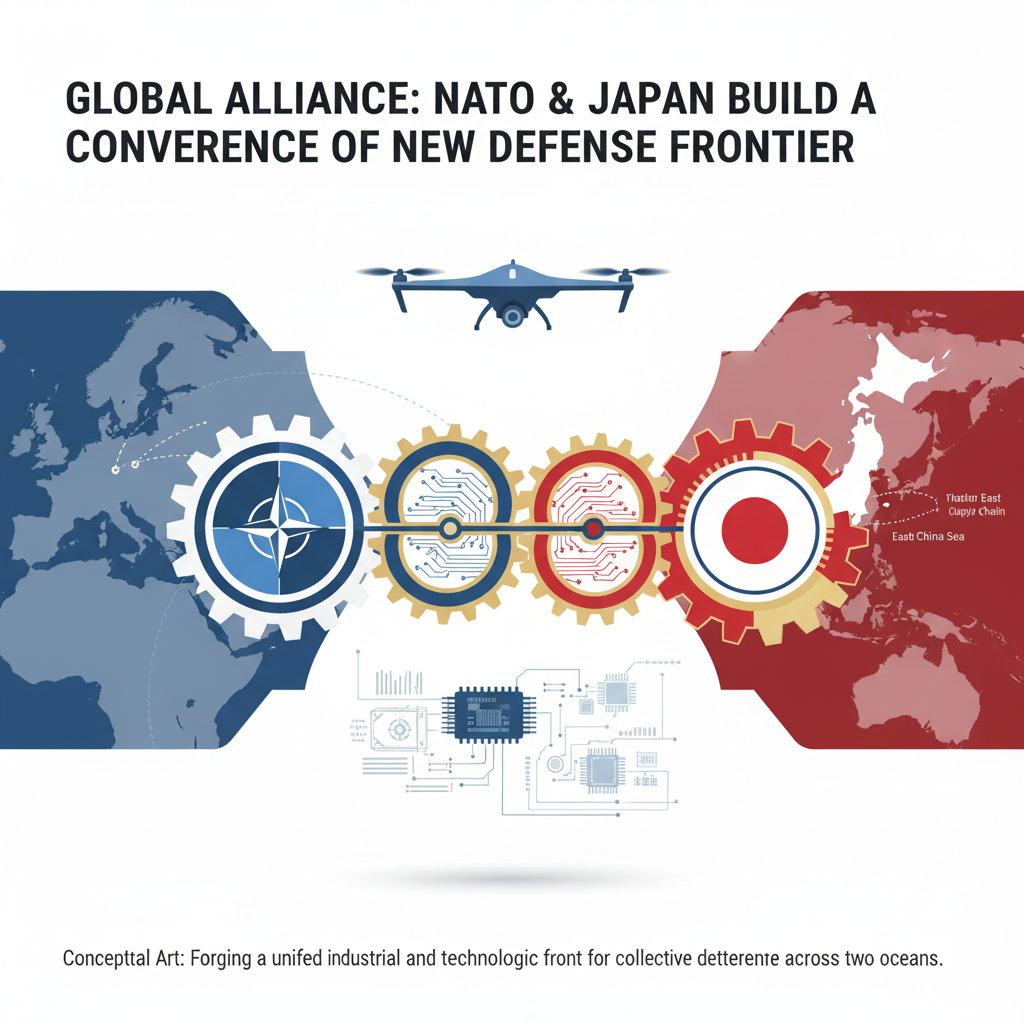
Brussels, Belgium — NATO and Japan held their first dedicated staff-to-staff dialogue on Defence Industrial Cooperation and Capabilities on Friday (October 31). The meeting, which took place at NATO Headquarters, marks a significant institutionalization of the partnership between the Euro-Atlantic alliance and its key Indo-Pacific partner.
The dialogue is a direct response to the increasing recognition that security challenges in the Euro-Atlantic (like the war in Ukraine) and the Indo-Pacific (concerns over China and North Korea) are deeply interconnected.
Key Discussion Points and Focus Areas:
The high-level talks focused on practical ways to integrate and bolster the defense-industrial base of both sides, with the main topics including:
-
Uncrewed Systems (UAS/Drones): Collaboration on the development and counter-measures for Uncrewed Aerial Systems.
-
Innovation and Technology: Exploring opportunities to leverage Japan's advanced capabilities in areas like Science and Technology (S&T) and dual-use technologies (such as AI, space, and quantum computing).
-
Supply Chain Resilience: Working to secure and standardize defense supply chains to ensure timely production and delivery of critical equipment, a crucial lesson from the Ukraine conflict.
-
Multinational Projects: Discussing Japan's potential future engagement in NATO's existing multinational projects across land, air, maritime, and space domains.
Significance of the Move:
The formal dialogue reinforces NATO's strategy to deepen cooperation with its Indo-Pacific partners (Australia, Japan, the Republic of Korea, and New Zealand) to uphold the rules-based international order.
For Japan, which is undergoing its largest defense modernization drive in decades, this provides an essential link to European and North American defense markets, promoting standardization and joint production.
In essence, this initial dialogue is seen as a crucial step towards creating a more resilient and integrated cross-regional industrial network capable of sustaining collective deterrence across both the Euro-Atlantic and Indo-Pacific theaters.
🌎 Geopolitical Analysis: The Strategic Convergence of NATO and Japan
The decision to formalize defence industrial cooperation between the North Atlantic Treaty Organization and Japan signifies a major strategic shift: the explicit acknowledgment that Euro-Atlantic and Indo-Pacific security are indivisible. This partnership is driven by a shared perception of increasing threat from authoritarian states, primarily China and Russia.
I. Strengthening the Rules-Based Order (The Grand Strategy)
The primary goal of this cooperation is to reinforce the global "rules-based international order" that has benefited both regions since World War II.
-
Bridging the Theatres: For NATO, Japan is the single most important partner for extending its influence and information gathering into the Indo-Pacific, creating a continuous defense-industrial front from the Baltic Sea to the South China Sea.
-
A Multilayered Deterrent: The alliance strengthens the overall deterrence against potential aggressors like China (concerning Taiwan) and Russia (concerning Ukraine/Europe). By linking two major defense industrial bases, the cost of aggression for adversaries is raised significantly, as they would face a globally coordinated response in terms of sanctions, technology denial, and defense materiel.
II. Technological and Industrial Resilience (The Practical Shift)
The core of the new dialogue focuses on the defense industry, which has several major implications:
| Area of Cooperation | Benefit for NATO/Japan | Geopolitical Impact |
| Supply Chain Security | Reduces reliance on single-source production (especially for critical minerals and components often sourced from China). | Creates resilient, friendly-shored supply chains that can operate smoothly during a major conflict without falling apart due to logistics or sanctions. |
| New Technologies | NATO gains access to Japanese innovation (AI, robotics, counter-UAS technology). Japan gains expertise in standardization and integration with Western systems. | Ensures democratic nations maintain a technological edge in emerging and disruptive technologies (EDTs), countering the advances made by China and Russia in these critical domains. |
| Interoperability | Allows Japanese and NATO forces to potentially work together more effectively in non-combat roles (like logistics, medical support, or humanitarian relief) and share non-classified intelligence more efficiently. | Normalizes Japanese global security involvement, leveraging its Self-Defense Forces (SDF) in ways that align with its new security strategy, which is more proactive globally. |
III. Implications for China and Russia
This deepening partnership is directly perceived as a challenge by Beijing and Moscow, who often criticize NATO's "expansion" into Asia.
-
China's Dilemma: This cooperation complicates China's regional strategy by strengthening its neighbors (like Japan) and bringing a unified European-American industrial base to its doorstep. It is seen as an effort to counter China's increasingly assertive regional behavior (e.g., in the Taiwan Strait and South China Sea).
-
Russia's Weakening: For Russia, the partnership ensures long-term industrial support for Ukraine, as Japan has been a major contributor to the NATO-led assistance packages. Furthermore, it counters the growing military and economic alignment between Russia and China, especially in areas like the Arctic.
Challenges to the Partnership
Despite the clear strategic convergence, challenges remain:
-
Geographical Distance: Logistics, cultural differences, and the sheer distance between the two theatres complicate real-time, high-level military cooperation.
-
The "Asian NATO" Narrative: Opponents, particularly China, will exploit the narrative that NATO is attempting to expand its military alliance structure into the Indo-Pacific, which can create friction with other non-aligned nations in the region.
-
Japan's Constitution: While Japan's defense posture has evolved, its commitment to international joint efforts remains constrained by its pacifist constitution, limiting its ability to engage in combat operations far from its borders.
The NATO-Japan defense industrial dialogue is a long-term investment in collective deterrence, signaling a future where the security of the Atlantic and Pacific is managed as a single, interdependent strategic space.
