


The Sovereign of the Seas: Exploring the Enigmatic God Varuna
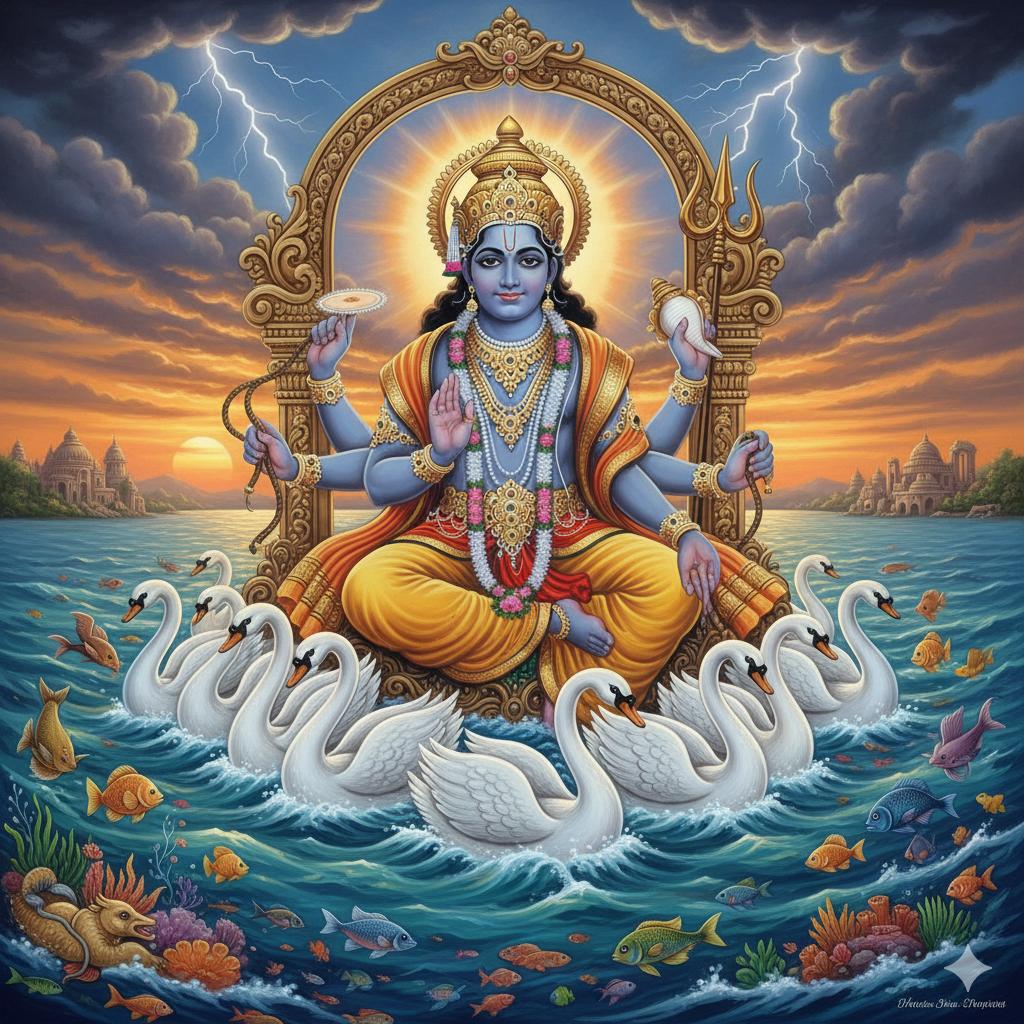
In the vast and ancient pantheon of Hindu deities, few figures possess a more profound and evolving history than Varuna. Often revered today as the mighty God of the Oceans, his story is a captivating journey through cosmic sovereignty, moral law, and the elemental force of water itself.
The King of Cosmic Order (Ṛta)
To truly understand Varuna, we must first look back to the Vedic age, where he held a position of supreme importance. In the Rigveda, Varuna was not merely a water deity; he was the Samraja (Universal Monarch), the ultimate upholder of Ṛta—the cosmic and moral order.
This ancient concept of Ṛta is the very structure of the universe: the rhythm of day and night, the change of seasons, and the laws of righteousness that govern both gods and humans. Varuna was the vigilant enforcer of this order.
-
Omniscience: Varuna is described as having a thousand eyes (the stars and the sun are often called his eye) with which he watches over the world, knowing every thought and deed of mortals.
-
Justice and Forgiveness: His justice was absolute. He punishes wrongdoers with his symbolic weapon, the Pāśa (Noose), which binds those who stray from truth (Satya). Yet, he is also a god of profound mercy, invoked for forgiveness and purification by those who sincerely repent.
The Lord of the Waters
While his initial role encompassed the sky and cosmic law, Varuna's most enduring association is with water. He is the sovereign of Apah, the primeval celestial waters that are the source of all creation, and later, the lord of the physical oceans, rivers, and all water bodies. This link makes him a vital deity for life, fertility, and the well-being of the earth.
A Transformation in Mythology
Over time, the prominence of Varuna shifted. As other powerful deities like Indra (God of Thunder and War) rose in the pantheon, Varuna's role narrowed.
In later Hindu texts, such as the Puranas and epics like the Ramayana and Mahabharata, Varuna is firmly established as:
-
The God of the Waters (Jalapati or Sāgara): The ruler of the vast, mystical realm beneath the waves.
-
A Dikpala (Guardian of Direction): Specifically assigned as the protector of the Western direction, where the sun sets into the ocean.
A famous episode in the Ramayana illustrates this shift: when Lord Rama seeks to cross the ocean to Lanka, he prays to Varuna. Initially silent, Varuna only appears when Rama, frustrated, threatens to dry up the entire sea—a moment that highlights Varuna's immense power over the element, even as his supremacy over all gods had waned.
Iconography and Symbolism
Varuna's typical depiction is as a dignified, regal figure.
-
Vehicle (Vahana): He rides the Makara, a mythical sea creature often described as a mix between a crocodile, dolphin, or a large fish-antelope.
-
Weapon: His characteristic weapon is the Pāśa (Noose), representing his power to bind and enforce law.
-
Abode: His palace is often described as submerged deep within the ocean, lavishly decorated with gold and jewels, the court attended by various aquatic beings and celestial nymphs.
An Enduring Legacy
Varuna's story is a beautiful testament to the dynamic nature of Hindu theology. He serves as a powerful reminder that divinity is not static, but adapts and evolves. Today, even as a directional guardian, his importance endures.
He is the element that sustains life, the moral compass that demands truth, and the unseen force that maintains the intricate order of the cosmos. Next time you stand before the vast, endless ocean, remember Bhagwan Varuna—the ancient king whose justice is as deep as the sea and whose vision is as boundless as the sky.
