


• Adenosine Deaminase (ADA)(Pericardial fluid) New
    880.00₹
    In stock
    Hyderabad
    0 Reviews
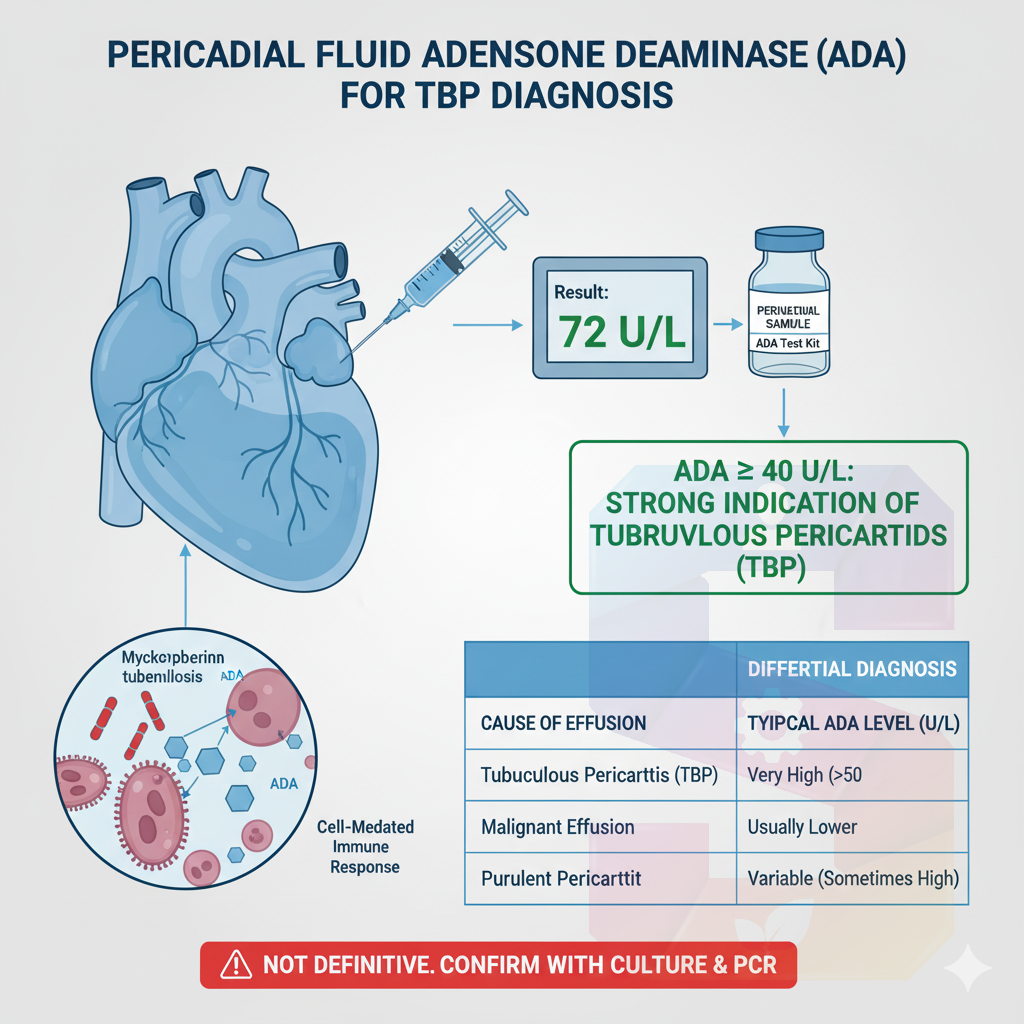
    Adenosine Deaminase (ADA) activity in pericardial fluid is a highly valuable, rapid, and cost-effective biomarker used for the diagnosis of Tuberculous Pericarditis (TBP).
    Key Concepts and Mechanism
    Primary Role: The main utility of measuring pericardial fluid ADA is to rapidly differentiate TBP (Tuberculosis of the heart sac) from other causes of pericardial effusion (fluid around the heart), such as malignancy or non-tuberculous infections.
    Source: ADA is mainly produced by T-lymphocytes and macrophages as part of the cell-mediated immune response.
    TBP Pathogenesis: In TBP, the Mycobacterium tuberculosis bacteria stimulate a vigorous local immune reaction, leading to a high concentration of ADA-releasing T-lymphocytes migrating into the pericardial space.
    Diagnostic Interpretation
    Tuberculous Pericarditis (TBP): ADA levels are typically markedly elevated in TBP.
    Cut-off Value: A commonly accepted and highly reliable cut-off value for suggesting TBP is \ge 40 \text{ U/L} (or IU/L).
    Note: Some studies suggest a cut-off of \ge 50 \text{ U/L} for even higher specificity.
    Performance: At the \ge 40 \text{ U/L} threshold, pericardial fluid ADA generally demonstrates high sensitivity (87-93%) and high specificity (83-97%) for diagnosing TBP.
    Differential Diagnosis:
    High ADA : Strongly suggests TBP.
    Low ADA : Essentially rules out TBP in a patient with a low pre-test probability, but high levels can rarely be seen in purulent (bacterial) pericarditis or certain malignancies.
    Adenosine Deaminase (ADA) activity in pericardial fluid is a highly valuable, rapid, and cost-effective biomarker used for the diagnosis of Tuberculous Pericarditis (TBP). Key Concepts and Mechanism Primary Role: The main utility of measuring pericardial fluid ADA is to rapidly differentiate TBP (Tuberculosis of the heart sac) from other causes of pericardial effusion (fluid around the heart), such as malignancy or non-tuberculous infections. Source: ADA is mainly produced by T-lymphocytes and macrophages as part of the cell-mediated immune response. TBP Pathogenesis: In TBP, the Mycobacterium tuberculosis bacteria stimulate a vigorous local immune reaction, leading to a high concentration of ADA-releasing T-lymphocytes migrating into the pericardial space. Diagnostic Interpretation Tuberculous Pericarditis (TBP): ADA levels are typically markedly elevated in TBP. Cut-off Value: A commonly accepted and highly reliable cut-off value for suggesting TBP is \ge 40 \text{ U/L} (or IU/L). Note: Some studies suggest a cut-off of \ge 50 \text{ U/L} for even higher specificity. Performance: At the \ge 40 \text{ U/L} threshold, pericardial fluid ADA generally demonstrates high sensitivity (87-93%) and high specificity (83-97%) for diagnosing TBP. Differential Diagnosis: High ADA : Strongly suggests TBP. Low ADA : Essentially rules out TBP in a patient with a low pre-test probability, but high levels can rarely be seen in purulent (bacterial) pericarditis or certain malignancies.
    0 Comments 0 Shares 1K Views 0 Reviews
  • Adenosine Deaminase (ADA) Pleural fluid New
    880.00₹
    In stock
    Hyderabad
    0 Reviews
    Adenosine Deaminase (ADA) measurement in pleural fluid is a widely used, highly effective, and cost-efficient diagnostic tool, primarily for the diagnosis of Tuberculous Pleurisy (TP).
    Key Concepts and Mechanism
    Primary Utility: Pleural fluid ADA is particularly useful for differentiating tuberculous exudative pleural effusions from other causes, especially malignant or parapneumonic effusions.
    Enzyme Source: As with other body fluids, ADA is an enzyme released predominantly by activated T-lymphocytes and macrophages.
    Pathogenesis in TP: In tuberculous pleurisy, the Mycobacterium tuberculosis infection triggers a strong cell-mediated immune response in the pleural space. This leads to the accumulation of lymphocytes that release ADA, causing elevated levels in the pleural fluid.
    Diagnostic Interpretation
    Tuberculous Pleurisy (TP): Pleural fluid ADA levels are typically significantly elevated in TP.
    Cut-off Value: While there can be slight variations, a commonly accepted and highly reliable cut-off value for suggesting TP is \ge 40 \text{ U/L} (or IU/L).
    Note: Some studies use cut-offs between 30-60 \text{ U/L}, but 40 \text{ U/L} is most prevalent for high diagnostic accuracy.
    Diagnostic Performance: At the \ge 40 \text{ U/L} threshold, pleural fluid ADA demonstrates high sensitivity (around 90-100%) and high specificity (around 85-95%) for diagnosing TP. This makes it an excellent rule-in and rule-out test for TP.
    Low ADA (: A low ADA level makes the diagnosis of TP highly unlikely, especially in populations with low TB prevalence.
    Adenosine Deaminase (ADA) measurement in pleural fluid is a widely used, highly effective, and cost-efficient diagnostic tool, primarily for the diagnosis of Tuberculous Pleurisy (TP). Key Concepts and Mechanism Primary Utility: Pleural fluid ADA is particularly useful for differentiating tuberculous exudative pleural effusions from other causes, especially malignant or parapneumonic effusions. Enzyme Source: As with other body fluids, ADA is an enzyme released predominantly by activated T-lymphocytes and macrophages. Pathogenesis in TP: In tuberculous pleurisy, the Mycobacterium tuberculosis infection triggers a strong cell-mediated immune response in the pleural space. This leads to the accumulation of lymphocytes that release ADA, causing elevated levels in the pleural fluid. Diagnostic Interpretation Tuberculous Pleurisy (TP): Pleural fluid ADA levels are typically significantly elevated in TP. Cut-off Value: While there can be slight variations, a commonly accepted and highly reliable cut-off value for suggesting TP is \ge 40 \text{ U/L} (or IU/L). Note: Some studies use cut-offs between 30-60 \text{ U/L}, but 40 \text{ U/L} is most prevalent for high diagnostic accuracy. Diagnostic Performance: At the \ge 40 \text{ U/L} threshold, pleural fluid ADA demonstrates high sensitivity (around 90-100%) and high specificity (around 85-95%) for diagnosing TP. This makes it an excellent rule-in and rule-out test for TP. Low ADA (: A low ADA level makes the diagnosis of TP highly unlikely, especially in populations with low TB prevalence.
    0 Comments 0 Shares 1K Views 0 Reviews
  • Adenosine Deaminase (ADA)(PUS) New
    1,400.00₹
    In stock
    Hyderabad
    0 Reviews
    The relationship between Adenosine Deaminase (ADA) and Pus primarily involves the use of an ADA test on pus samples as a diagnostic tool for certain infections, particularly Tuberculosis (TB).
    1. 🔍 ADA Test on Pus
    Purpose: The ADA Test - Pus measures the level of the Adenosine Deaminase enzyme in a pus sample. Pus is a thick, cloudy fluid containing white blood cells that accumulates at a site of infection.
    Enzyme Role: ADA is an enzyme involved in purine metabolism. It is crucial for the proliferation and differentiation of lymphocytes (a type of white blood cell), especially T-lymphocytes.
    Clinical Significance:
    Elevated ADA levels in pus can indicate an immune response, commonly observed in tuberculous abscesses or other inflammatory processes.
    The test is used to help diagnose tuberculosis (TB) when it cannot be easily confirmed by other methods, such as acid-fast bacilli (AFB) smear.
    High ADA activity in fluid/debris, like pus, is highly suggestive of infection with Mycobacterium tuberculosis (TB bacteria).
    2. 🧬 ADA Deficiency (ADA-SCID)
    While the ADA test in pus relates to infection diagnosis, a different and more severe condition is caused by a lack of the ADA enzyme.
    What it is: Adenosine Deaminase Deficiency is a rare, inherited disorder that results in a severe form of Severe Combined Immunodeficiency (SCID), often called ADA-SCID.
    The relationship between Adenosine Deaminase (ADA) and Pus primarily involves the use of an ADA test on pus samples as a diagnostic tool for certain infections, particularly Tuberculosis (TB). 1. 🔍 ADA Test on Pus Purpose: The ADA Test - Pus measures the level of the Adenosine Deaminase enzyme in a pus sample. Pus is a thick, cloudy fluid containing white blood cells that accumulates at a site of infection. Enzyme Role: ADA is an enzyme involved in purine metabolism. It is crucial for the proliferation and differentiation of lymphocytes (a type of white blood cell), especially T-lymphocytes. Clinical Significance: Elevated ADA levels in pus can indicate an immune response, commonly observed in tuberculous abscesses or other inflammatory processes. The test is used to help diagnose tuberculosis (TB) when it cannot be easily confirmed by other methods, such as acid-fast bacilli (AFB) smear. High ADA activity in fluid/debris, like pus, is highly suggestive of infection with Mycobacterium tuberculosis (TB bacteria). 2. 🧬 ADA Deficiency (ADA-SCID) While the ADA test in pus relates to infection diagnosis, a different and more severe condition is caused by a lack of the ADA enzyme. What it is: Adenosine Deaminase Deficiency is a rare, inherited disorder that results in a severe form of Severe Combined Immunodeficiency (SCID), often called ADA-SCID.
    0 Comments 0 Shares 1K Views 0 Reviews
  • ADH (Antidiuretic Hormone Vasopressin), EDTA Plasma(ADH) New
    5,750.00₹
    In stock
    Hyderabad
    0 Reviews
    Hormone Role: Antidiuretic Hormone (ADH), also known as Arginine Vasopressin (AVP), is produced in the hypothalamus and released by the posterior pituitary gland. Its primary function is to regulate water balance by increasing water reabsorption in the kidneys, thus concentrating urine and conserving body fluid.
    Clinical Use: The test measures ADH levels in the blood to help diagnose disorders of water metabolism, such as:
    Diabetes Insipidus (DI): Caused by ADH deficiency (Central DI) or kidney unresponsiveness to ADH (Nephrogenic DI).
    Syndrome of Inappropriate Antidiuretic Hormone (SIADH): Caused by excessive ADH production, leading to water retention and low blood sodium (hyponatremia).
    Test Context: ADH levels are often interpreted alongside serum and urine osmolality and electrolytes, or as part of specialized procedures like the Water Deprivation Test.
    Hormone Role: Antidiuretic Hormone (ADH), also known as Arginine Vasopressin (AVP), is produced in the hypothalamus and released by the posterior pituitary gland. Its primary function is to regulate water balance by increasing water reabsorption in the kidneys, thus concentrating urine and conserving body fluid. Clinical Use: The test measures ADH levels in the blood to help diagnose disorders of water metabolism, such as: Diabetes Insipidus (DI): Caused by ADH deficiency (Central DI) or kidney unresponsiveness to ADH (Nephrogenic DI). Syndrome of Inappropriate Antidiuretic Hormone (SIADH): Caused by excessive ADH production, leading to water retention and low blood sodium (hyponatremia). Test Context: ADH levels are often interpreted alongside serum and urine osmolality and electrolytes, or as part of specialized procedures like the Water Deprivation Test.
    0 Comments 0 Shares 1K Views 0 Reviews
  • Advance Fever Profile package New
    2,500.00₹
    In stock
    Hyderabad
    0 Reviews
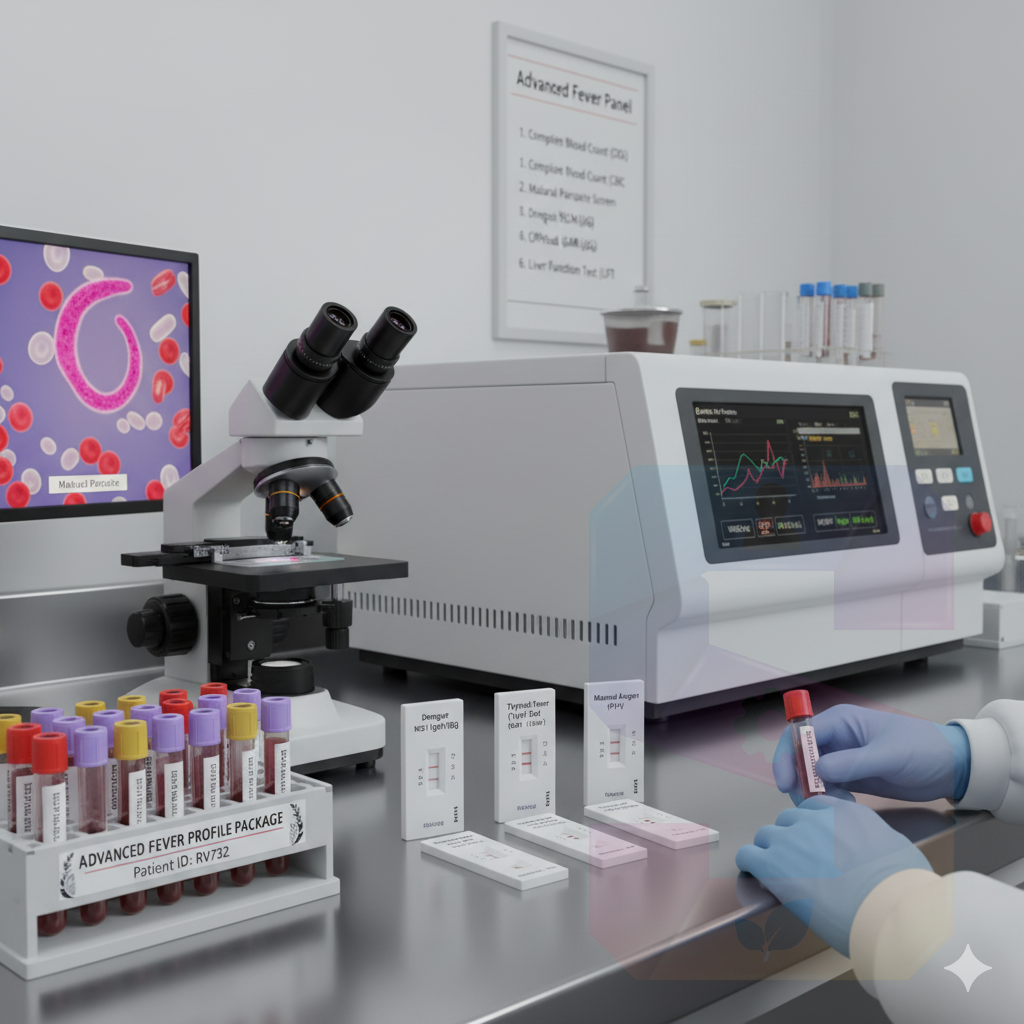
    The Advance Fever Profile Package is a comprehensive panel of laboratory tests designed to rapidly and thoroughly investigate the underlying cause of a fever that is persistent, unexplained, or accompanied by severe symptoms.
    1. 🎯 Purpose and Utility
    Rapid Diagnosis: Aims to quickly differentiate between common causes of fever (viral, bacterial, parasitic) to enable prompt and targeted treatment.
    Comprehensive Screening: Includes a wide range of markers to check for specific infections, inflammation, and potential organ damage.
    Disease Targets: Primarily screens for common endemic infections, including: Dengue, Malaria, and Typhoid (Enteric Fever).
    This package consists of: sgpt, sgot, ESR, CBC, CRP, malarial Antigen Detection, Typhi Dot IgG& IgM, Dengue IgG& IgM
    The Advance Fever Profile Package is a comprehensive panel of laboratory tests designed to rapidly and thoroughly investigate the underlying cause of a fever that is persistent, unexplained, or accompanied by severe symptoms. 1. 🎯 Purpose and Utility Rapid Diagnosis: Aims to quickly differentiate between common causes of fever (viral, bacterial, parasitic) to enable prompt and targeted treatment. Comprehensive Screening: Includes a wide range of markers to check for specific infections, inflammation, and potential organ damage. Disease Targets: Primarily screens for common endemic infections, including: Dengue, Malaria, and Typhoid (Enteric Fever). This package consists of: sgpt, sgot, ESR, CBC, CRP, malarial Antigen Detection, Typhi Dot IgG& IgM, Dengue IgG& IgM
    0 Comments 0 Shares 1K Views 0 Reviews
  • Savitr: The Golden God of Inspiration and Creation in the Rigveda
    In the glittering pantheon of Hindu gods, one deity shines with a light that is both physical and spiritual: Savitr. Often translated as "The Impeller," "The Awakener," or "The Creator," Savitr is a prominent solar deity from the Rigveda, the oldest text of Hinduism, whose significance goes far beyond mere sun worship. He is the divine force that inspires and activates all of existence....
    0 Comments 0 Shares 762 Views 0 Reviews
  • Love Time | AI Music Video
    Love Time | AI Music Video
    0 Comments 0 Shares 444 Views 20 0 Reviews
  • https://www.secureserver.net/?pl_id=523784
    https://www.secureserver.net/?pl_id=523784
    0 Comments 0 Shares 617 Views 0 Reviews
  • The Ribhus: Divine Artisans and the Path to Immortality
    In the vast and intricate tapestry of Hindu mythology, especially the ancient Rigveda, a group of deities holds a unique and profoundly inspiring position: the Ribhus (Ṛbhus). They are not gods born of primordial elements or cosmic forces, but instead, represent the extraordinary potential of human skill, effort, and ingenuity to achieve divine status. They are the ultimate testament to the...
    0 Comments 0 Shares 558 Views 0 Reviews
  • ☀️ Pushan: The Radiant Guide and Protector of Paths
    In the rich pantheon of Hindu deities, there are gods who preside over grand cosmic forces, and then there are those like Pushan (Pūṣan), whose domain is more focused, yet profoundly essential to the everyday life and spiritual journey of humanity. Mentioned prominently in the Rigveda, Pushan is a radiant and benevolent deity, often associated with prosperity, journeys, and the protection...
    0 Comments 0 Shares 497 Views 0 Reviews
Sponsored